

Events like the “India AI Impact Summit 2026” pitch AI as the revolutionary force for the present and future. However, AI is not the only thing that is at the forefront of companies and their leaders when it comes to the future of the workforce.
During the “Reskilling for Tomorrow: AI, Sustainability, and India’s Jobs Transition” session, Aditi Jha, Board Director | Head: Legal & Public Policy at LinkedIn, highlighted the two changes that the global workforce is undergoing at this very moment:
- Climate Change
- AI Revolution
Even as companies across India adopt AI in their workflows, they are also becoming increasingly focused on making their operations more sustainable, all to minimise the impact of the changing climate.
This has led to increased demand for green skills. This set of knowledge, abilities, values and attitudes, as per the United Nations Industrial Development Organisation (UNIDO), is needed to live in, develop and support a sustainable and resource-efficient society.
Within India, green skills are becoming part of the core business skills, rather than something that is “just good to have,” as per Jha. She emphasised that people with green skills are being hired faster than their colleagues. Jha also highlighted that green hiring in India is increasing at a much higher rate than the growth of green skills in India’s workforce.
India’s Green Vision
During the India AI Impact Summit 2026, Union Minister Ashwini Vaishnaw highlighted how India is working on all five layers of the AI stack. The fifth layer of this technical stack focuses on creating sustainable practices.
“The fifth layer is the energy layer,” Vaishnaw stated. “Friends, it’s the commitment towards clean energy that our honourable Prime Minister has always shown, and that’s why in our country today, more than 50% of the power generation capacity is from clean sources, from renewable sources.”
Vaishnaw’s words highlight the growing importance of the green economy and how AI can support it.
The Green Skill Need
As per a WeNaturalists report, cited by the Economic Times, green jobs in India have grown by more than 10 times over the past five years. Gen Z accounts for 63% of applicants for these jobs, highlighting the new generation’s understanding of sustainability.
The LinkedIn Green Skills Report 2025, released in November 2025, agreed that green jobs are indeed on the rise in India. The report stated that, on average, the share of green hires has increased at an annual rate of 5.3% between 2021 and 2025.
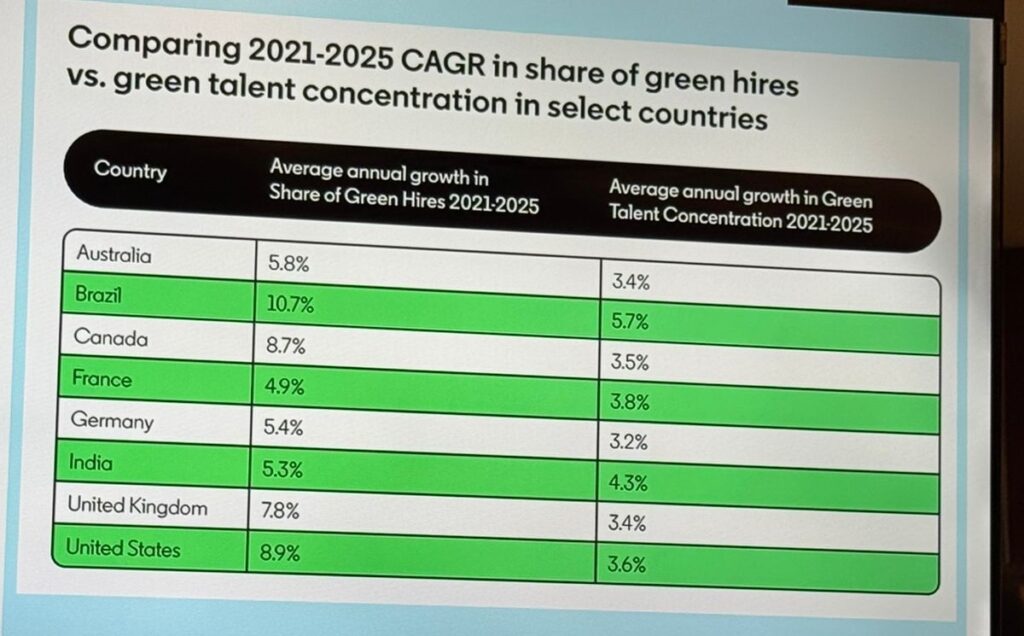
On the other hand, the average annual growth in green talent concentration between 2021 and 2025 came to around 4.3%. Bridging the gap between hiring growth and skill growth in the green industry is a priority for companies and the country.
To combat this gap, India’s Ministry of Skills Development and Entrepreneurship established the Skill Council for Green Jobs (SCGJ) in 2015. The institution has expanded to include over 1200 providers and 500 trainers. Together, they are facilitating more than 56 programmes that have reached more than 6,00,000 learners.
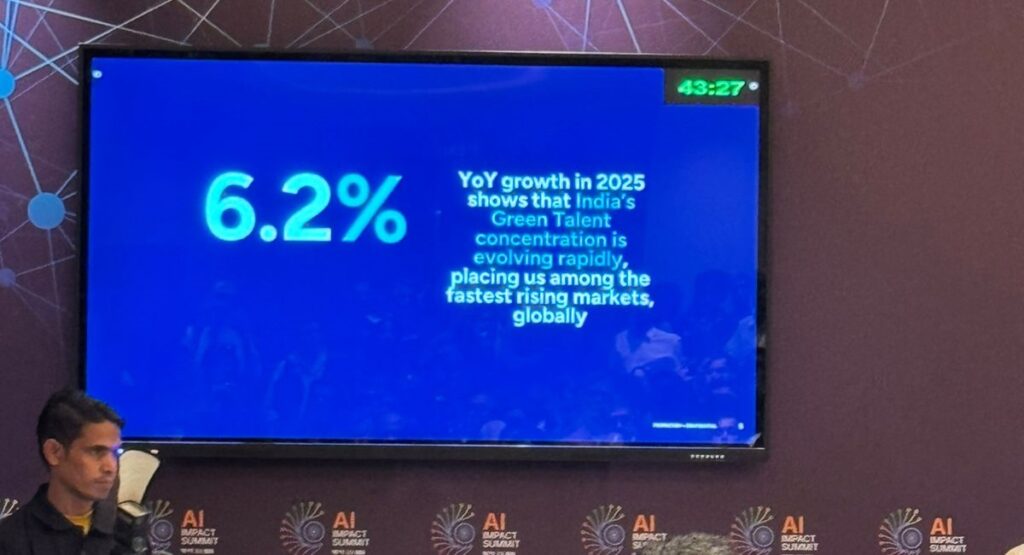
The efforts of countries and India itself have shown remarkable progress in the country’s screen skills capabilities. In 2025, India recorded a year-on-year growth rate of 6.2% in green talent, making it one of the highest among countries.
Though the country’s current green talent concentration rate is still low at 14.4%, the impressive growth rates promise a better future for all. Even within India, the green economy ranks as the fastest-growing skill area in India, followed by weather forecasting, electric vehicle operation, responsible supply chain management, and sustainable growth.
Progressing Towards the Green with AI
During the session, Jha raised a critical question: How can AI be used for sustainability? For a technology that uses a huge amount of resources, including water, its inclusion in the sustainability moment might seem counterintuitive to some.
However, by leveraging AI to optimise efficiency and increase energy savings, Jha believes we can create a future workforce that won’t be divided between technology and climate. What the companies and India need to learn is how to align training systems fast enough with growing green needs to create a sustainable workflow.
Within the Indian technology industry, operational efficiency has grown by 110% with the help of AI, hence reducing energy and resource consumption.
Future of India with Green AI
The applications of AI have already shown promise for the green economy, as humans and technology work together toward a better, greener future. India, in particular, is focused on creating a world where the next generation can work hand in hand with technology without worrying about the environmental cost.
In fact, India has already achieved its target of powering over 50% of its electricity generation capacity from non-fossil fuels. The target was achieved in July 2025, five years ahead of the intended 2030 target date, as per the 2015 Paris Agreement.
A major focus is on green jobs and the green economy. As per NLB Services, the country’s green economy is set to generate 7.29 million jobs by FY28 and 35 million by 2047. This will ultimately boost India’s green economy, likely reaching $1 trillion by 2030 and $15 trillion by 2070.
The combination of the green economy and AI is bound to create more innovative and efficient pathways to combat the adverse effects of climate change, resource consumption, and fossil fuel use. While AI itself comes with vast energy costs, the goal of industries remains to offset this by increasing efficiency at massive rates.