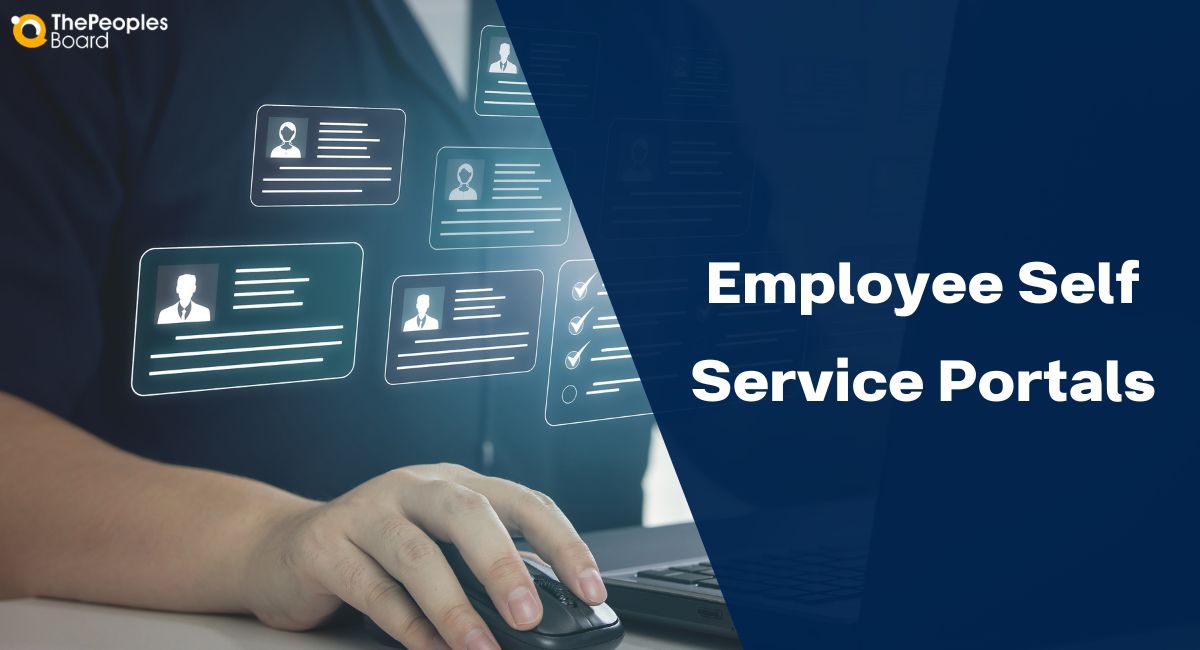

An employee self-service (ESS) portal lets staff handle routine HR tasks themselves, things like viewing payslips, updating personal details, applying for leave, declaring taxes, and enrolling in benefits, without routing each request through the HR team. For HR functions in India, where a single department often serves hundreds of employees across multiple states and compliance regimes, that shift changes what HR spends its day doing.
The logic is simple. Most of what employees ask HR for is information they already have or transactions that follow a fixed rule. A self-service portal moves those interactions to the employee, keeps a digital record of each one, and frees HR to focus on work that actually needs human judgment.
What is an Employee Self-Service Portal?
An employee self-service (ESS) portal is a secure, web or app-based platform that lets employees access HR information and complete routine HR transactions on their own. It usually lives within a broader HR information system (HRIS) and connects to payroll, attendance, and benefits modules, ensuring that the data an employee sees is the same data HR uses.
The purpose is to remove HR as the middle layer for tasks that do not require it. Instead of emailing HR for a salary slip and waiting two days, an employee logs in and downloads it. Instead of HR keying in a new bank account or address, the employee enters it directly and the record updates at source.
This changes HR operations in three concrete ways:
- The request channel shifts: Routine queries that once landed in an HR inbox now resolve inside the portal, so HR handles fewer tickets and more exceptions.
- Data entry moves to the owner: Employees maintain their own records, which reduces the transcription errors that creep in when HR re-enters information by hand.
- Every action leaves a trail: Because the portal logs who changed what and when, HR gains an audit record that manual processes never produced.
A useful comparison is online banking. You no longer visit a branch to check a balance or move money for routine transactions. The bank handles the complex and the exceptional; you handle the rest. ESS applies the same split to HR. For organisations weighing this shift, the choice of platform matters as much as the decision itself, which is why selecting the right HR software comes before any rollout.
Common Employee Tasks That Can Be Self-Managed
Not everything in HR can or should be handed off. But a large share of day-to-day transactions can. The table below maps the most common tasks to what self-service typically allows.
| Task | What Employees Can Do | What Usually Stays With HR |
| Personal information | Update address, phone, emergency contact, and bank details | Approve changes that affect statutory records |
| Payslips and pay history | View and download payslips, salary breakups, and Form 16 | Run and finalise payroll |
| Leave | Apply for leave, check balances, track approval status | Set leave policy, resolve disputes |
| Attendance | View attendance records, regularise missed punches | Approve regularisations, manage shift rules |
| Tax declarations | Submit investment proofs, choose tax regime, declare deductions | Validate proofs, finalise TDS |
| Benefits | Enrol in or change benefit plans during open windows | Configure plans, manage vendor relationships |
Personal Information Updates
Address changes, new phone numbers, updated bank accounts, and emergency contacts are among the most frequent HR requests, and among the least suited to HR effort. A portal lets employees update these directly. The change flows into the system of record, and HR reviews only what affects statutory filings.
Payslip Access
Payslip and salary-slip requests spike every month and again at year-end when employees need Form 16. Self-service makes the full pay history available on demand, which removes a predictable monthly queue from the HR inbox. This connects directly to how payroll management is run, since the portal simply exposes data that the payroll engine already holds.
Leave Requests
Leave is the classic self-service use case. Employees apply, see their balance, and track approval status; managers approve in the same flow. The portal automatically enforces the leave policy, so HR no longer has to mediate every request or recalculate balances by hand.
Attendance Records
Employees can view their own attendance, see how it maps to payroll, and raise regularisation requests for missed punches. For field and shift workers, mobile attendance with geo-tagging feeds the same record, giving employees visibility they never had with manual registers.
Tax Declarations
During the investment-declaration window, HR in India fields a flood of proof submissions and tax-regime questions. Self-service lets employees declare investments, choose between the old and new tax regimes, and upload proofs directly, with HR validating them rather than collecting them. This reduces the seasonal bottleneck that tax season creates.
Benefit Enrollment
During open enrolment, employees can review benefit options, enrol, or change elections themselves. Group health insurance is a common example in which employees add dependents or switch plans within the portal. HR configures the plans and manages the insurer; employees handle their own choices.
What Employees Gain
The case for self-service is often framed around HR efficiency, but the employee experience is the reason adoption sticks. People use a portal when it is genuinely faster and clearer than asking HR.
- Faster access to information: Payslips, leave balances, and tax forms are available immediately, including outside office hours. There is no wait for an HR reply.
- Greater transparency: Employees can see their own records, approval status, and balances in real time, removing the guesswork about whether a request went through.
- Reduced dependency on HR: Routine tasks no longer require chasing someone, which matters most for employees at remote sites or in time zones different from the HR team.
The expectation is now widespread. Employees who manage their banking, travel, and bills on their phones increasingly expect the same from their workplace, and they treat slow, HR-mediated access to their own records as friction. For a young, mobile-first Indian workforce, on-demand access has shifted from a perk to a baseline expectation.
What HR Teams Gain
For HR, the payoff is the reclaimed time and the cleaner data that come from handing routine work to the people who own it.
- Lower administrative workload: The largest gain is the volume of routine requests that simply stop reaching HR. The cost logic behind that shift is well-documented. Gartner’s 2019 Customer Service and Support Leader poll found that resolving a query through a live channel, such as phone, chat, or email, costs about $8.01 per contact, against roughly $0.10 for a self-service channel like a website or mobile app. HR self-service runs on the same principle: a transaction an employee completes alone costs a fraction of what one handled by an HR person costs, and routine ones make up the bulk of the workload.
- Improved data accuracy: When employees enter and maintain their own information, the data is more current and carries fewer transcription errors than when HR rekeys it from emails or forms. Accurate source data matters most where it feeds statutory calculations such as PF, ESI, and TDS.
- More time for strategic initiatives: Every hour HR is not spending on payslip requests is an hour available for work that needs people, things like retention, workforce planning, and capability building. This is the shift that lets HR move from a processing function toward a strategic partner, the same transition that broader trends in HR technology are pushing across Indian organisations.
The direction of travel is clear across Indian organisations. Cloud HRMS platforms now ship self-service as a default rather than an upgrade, and the next layer is conversational: the growing use of AI-based HR assistants extends the same self-service logic, letting employees get answers by asking rather than by raising a ticket.
Risks and Governance Considerations
Handing tasks to employees does not remove HR’s responsibility for them. It changes how that responsibility is exercised, from doing the task to governing the system that does it. Three areas need attention.
Data Security
A self-service portal consolidates sensitive personal data, salary information, bank details, biometrics, and health records in one place, making it accessible to many people. In India, this now sits under a specific legal regime.
The Digital Personal Data Protection Act, 2023 and the accompanying Digital Personal Data Protection Rules, notified in November 2025, set out how organisations must collect, process, and secure personal data, with obligations including consent, data minimisation, reasonable security safeguards, and breach reporting.
According to EY’s analysis of the framework, the DPDP Rules emphasise user consent, data security, data principal rights, and breach reporting, and are rolled out in phases, with full compliance expected over an 18-month window.
For HR, that means an ESS portal must be built and configured to support encryption, role-based access, and consent records, not just to be convenient. Treating the portal as a compliance system and folding it into regular HR audit and compliance checks is now a legal expectation rather than a best practice.
Approval Controls
Self-service should not mean unsupervised change. The portal must distinguish between what employees can view, what they can change freely, and what needs approval.
An address update can flow straight through; a bank account change that affects salary credit, or an unusual benefit election, should be routed to a reviewer. Getting these rules right is the difference between empowerment and exposure.
Change Tracking
Because every action in a portal is logged, HR gains an audit trail that manual processes never produced. That trail is only useful if HR actually uses it. Periodic review of who changed what, flagged exceptions, and access logs turns the portal from a convenience into a control.
Under the DPDP framework, maintaining such records also supports the accountability obligations placed on the organisation as a data fiduciary.
Measuring Success
A portal that employees do not use delivers none of the benefits above. Measurement matters, both to prove value and to find where the rollout is failing. Three indicators give a clear read.
| Metric | What It Measures | Why It Matters |
| Adoption rate | Share of employees actively using the portal, ideally by feature | Low adoption signals friction or poor change management, not a bad tool |
| Reduction in HR tickets | Drop in routine queries reaching HR after rollout | The most direct evidence that work has shifted from HR |
| Employee satisfaction | Feedback on whether the portal helps or frustrates | Catches usability problems that usage numbers alone miss |
Adoption Rates
Track usage by feature, not just logins. Payslip access and leave requests usually drive the fastest uptake because employees want them; benefit or tax features may lag and need a nudge. Measuring by feature shows where to focus.
Reduction in HR Tickets
Compare the volume of routine requests before and after rollout. A meaningful drop confirms that the portal is absorbing work rather than sitting unused. The aim is to redirect HR effort, so a falling ticket count is the metric that ties back to the original goal.
Employee Satisfaction Indicators
Numbers show what employees do; surveys show why. A short pulse survey on the self-service experience surfaces the form that is hard to find or the flow that confuses people, problems that quietly suppress adoption. Pairing this with broader people analytics lets HR connect portal usage to outcomes such as query resolution time and engagement.
In the End…
Employee self-service does not shrink HR’s role. It sharpens it. The tasks that move to employees, payslips, leave, address changes, and tax declarations are the ones that never needed HR judgment in the first place. What stays is the work that does: policy, fairness, planning, and the human conversations that no portal can hold.
If you are weighing a portal, start with the tasks your team repeats most often and resents most, because those are where self-service pays back fastest. Then treat the rollout as a change-management project rather than a software install. The tool rarely fails on its own; adoption fails when employees are not brought along.
And under India’s new data-protection regime, remember that handing a task to an employee does not hand away your responsibility for the data behind it. The portal that empowers your workforce is also a system you are accountable for. Build it, govern it, and measure it as one.
FAQs
What is an employee self-service portal?
An employee self-service (ESS) portal is a secure web or app-based platform that lets employees access HR information and complete routine HR tasks themselves, such as viewing payslips, applying for leave, updating personal details, and declaring taxes. It usually sits within a broader HRIS and connects to payroll, attendance, and benefits data.
What HR tasks can employees handle through self-service?
Employees can typically update personal information, view and download payslips and Form 16, apply for leave and check balances, view attendance and raise regularisation requests, submit tax declarations and investment proofs, and enrol in benefits during open windows. Tasks that affect statutory records or need judgment, such as finalising payroll or validating proofs, stay with HR.
Does an ESS portal reduce HR’s workload?
Yes. The largest gain is the volume of routine requests that stop reaching HR, since employees resolve them inside the portal. Self-service transactions also cost a fraction of those handled by an HR person, and they improve data accuracy because employees maintain their own records rather than HR re-keying information.
Is an employee self-service portal compliant with India’s data protection law?
An ESS portal consolidates sensitive personal data, so it falls under the Digital Personal Data Protection Act, 2023 and the DPDP Rules notified in November 2025. The portal must support encryption, role-based access, consent records, and breach reporting, and should be folded into regular HR audit and compliance checks.
How do you measure whether an ESS portal is successful?
Three indicators give a clear read: adoption rate (share of employees actively using it, ideally by feature), reduction in HR tickets (the drop in routine queries after rollout), and employee satisfaction (pulse-survey feedback on usability). Low adoption usually signals friction or poor change management rather than a bad tool.