

- A study by Wheebox found that as many as 77% of the employers found it difficult to fill key roles, especially in IT, engineering, and healthcare industries.
- A democratic sheet of data about the skills of the employees within an organisation opens up options for a team manager to choose from the existing talent pool instead of looking for talent outside the organisation, which is both time-consuming and expensive.
With quickly evolving skills, roles are constantly reshaped, and business priorities shift faster than traditional HR cycles can keep up with. Under such circumstances, relying on intuition creates blind spots that organisations can no longer afford. Data provides the clarity, speed, and precision needed to understand workforce capabilities in real time, whether it’s identifying skill gaps, predicting attrition risks, planning internal movements, or designing personalised learning paths.
With the rise of GCCs in India, the country today serves as a significant location for several multinational companies from where a large chunk of the projects is controlled.
However, a study titled India Skills Report 2026 by Wheebox found that as many as 77% of the employers found it difficult to fill key roles, especially in IT, engineering, and healthcare industries.
What is painting this contradictory picture?
It is important to understand that as the workforce globalises, skills-based talent allocation and management have surfaced as a fresh challenge for the decision makers due to factors such as unevenly spread talent pool across geographies, fragmented business units, and project timelines. Due to such factors, managers lack information such as real-time visibility into who can do what, where they are located, or whether they are available.
Plus, global teams operate in different time zones, compliance environments, and workforce models (full-time, contract, gig, shared services, etc), which further complicates how skills can be deployed at scale.
This often creates a skills shortage. But, in a rapidly evolving employment landscape, what is the remedy? Instead of depending on the age-old ‘firing and hiring’ model, inter-team shifting of talent as per needs and relevance is what the HR professionals may explore. This is where ‘data democratisation’ takes over as the key to decision-making.
What is data democratisation in HR?
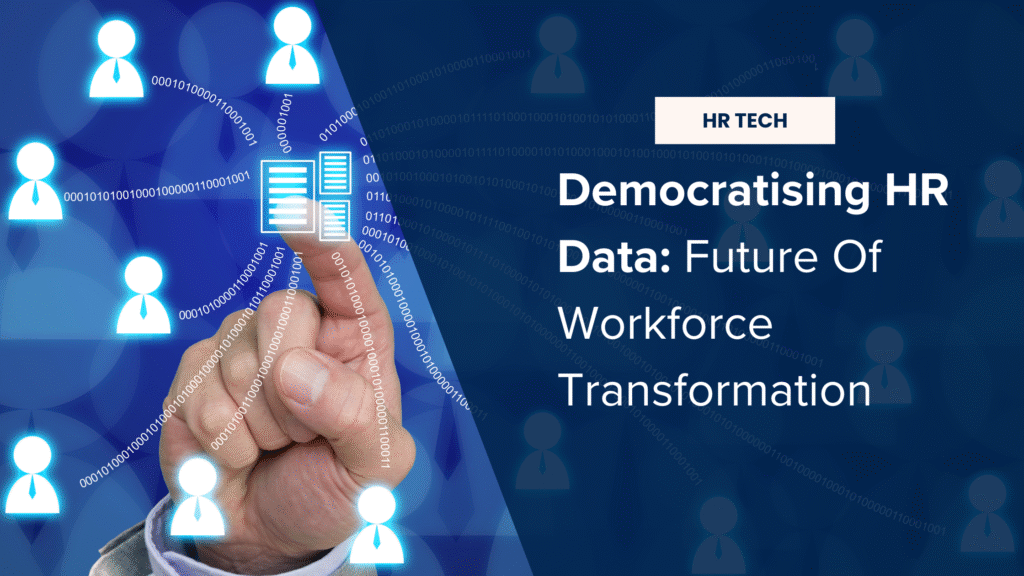
Data democratisation in HR refers to the practice of making people-related data accessible to the right stakeholders across an organisation, and not just the HR teams or data specialists, to enable leaders, managers, and sometimes even employees to use real-time insights to make better decisions.
As per HR.com’s State of People Analytics 2024-25 report, HRs use data for employee experience engagement (55%), retention (49%), performance management (49%), compensation and benefits (49%), and recruitment and selection (47%).
Here’s a simplified breakdown of how it works and why it is relevant:
- Controlled access to real-time people insights
A democratic sheet of data about the skills of the employees within an organisation opens up options for a team manager to choose from the existing talent pool instead of looking for talent outside the organisation, which is both time-consuming and expensive.
- It empowers faster decision-making
Lengthy notice periods, imperfect ATS matches, and unclear role definitions often slow down external hiring, and sometimes even cause strong candidates to drop off. New hires also require time to adapt to the company’s culture and workflows. In contrast, internal movement supported by real-time talent mapping reduces this lag significantly. Managers can identify ready talent instantly, make quicker decisions, and fill critical roles with people who already understand the organisation.
- Fosters skills-based workforce
When organisations have transparent visibility into the skills that exist across teams, they can pinpoint capability gaps with far greater accuracy. This enables targeted addressal of reskilling, upskilling, or redeployment, supporting the shift toward a truly skills-based workforce.
- Customised skills development solutions
In addition to accelerating the shift toward a skills-ready workforce, it gives organisations a clear view of the gaps and vulnerabilities within their existing talent pool. This visibility enables decision-makers to design more precise and aligned talent strategies with evolving market demands.
It also strengthens the role of learning and development teams, allowing them to create more targeted and personalised learning pathways that directly address identified skill gaps and support continuous workforce readiness.
What are the key challenges?
Privacy, Security, and Compliance Risks
According to a paper published on ResearchGate, unauthorised access to employee data, such as tracking employees without consent, increased the risks associated with HR analytics applications. Employee surveillance during the course of remote working has drawn a blurry line between privacy and productivity monitoring
Quoting a Gartner study, the paper further stated that the accelerated trend of workforce surveillance reveals that the implementation of these tracking systems has caused frustration for 60% of workers interviewed, an increase of twofold prior to the pandemic.
An employee database, in addition to skills, also carries sensitive information such as financial data, salary, performance analysis, etc. So, the chances of unauthorised sharing, weak passwords, phishing attacks, or accidental misuse increase.
Setting clarity on the degree of access to employee data
To ensure that data isn’t leaked, companies must set up a framework to keep checks on who can access data and to what extent. Team managers only need skills data, while others need project capacity or team health metrics.
Improper access design can cause overexposure of personal data, bias in decision-making, and confusion about what is appropriate to share.
Cultural resistance from HR teams
Traditionally, HR teams have been the sole owners of the employee database, leading to gatekeeping. A sudden shift may trigger the fear of misuse of data by less experienced managers. This cultural barrier slows adoption and creates friction between HR and business teams.
Intra-company poaching
When data on skills, performance, and experience becomes easily accessible across departments, high-performers can attract attention from multiple teams. This can trigger internal talent wars, department-level attrition, or destabilise project staffing. Without proper governance, democratised data may lead to teams competing for the same talent rather than collaborating to build long-term workforce capabilities.
Loose people analytics model
A democratised data environment requires accurate, standardised, and well-governed analytics models. However, many companies still have fragmented HR systems, inconsistent data definitions, outdated records, or incomplete talent profiles. If flawed or inconsistent data flows freely across the organisation, it leads to inaccurate insights, poor decisions, and loss of credibility in data-driven HR. A loose analytics foundation simply amplifies errors at scale.
How can the challenges be overcome?
Organisations need to treat HR data as a regulated asset, establishing explicit ownership, access protocols, and usage boundaries to ensure employee information can be shared without compromising privacy or compliance. To ensure data privacy for sensitive employee information, companies must design role- and hierarchy-based access controls.
Leaders need to adopt biasless hiring practices to make better-informed decisions. This, in turn, should also be able to control attrition and foster a competitive and productive workforce.
1. Treating HR Data as a Regulated Asset
Employee data today includes far more than basic inputs. Organisations now store behavioural analytics, performance trends, productivity signals, wellness indicators, payroll details, and even location metadata for remote workers.
2. Role-Based and Hierarchy-Based Access Is Critical
As HR data becomes more widely accessible across distributed teams, the risk of exposing unnecessary or deeply personal employee information increases. Such risks can be avoided by adopting the following measures:
- Business leaders view aggregated insights instead of individual details.
- Skills and capacity data can be open, but compensation or medical information remains restricted.
3. Biasless Hiring Practices Reduce Attrition and Strengthen Workforce Quality
Biasless hiring approaches such as skills-first evaluation, anonymised screening, and structured interviews may help leaders make decisions grounded in capability rather than intuition or familiarity. When paired with democratised, high-quality talent data, organisations can:
- Spot internal talent faster
- Reduce time-to-hire
- Improve fairness in promotions
- Prevent internal poaching from becoming destabilising
- Build stronger succession pipelines
What is the future?
Data is the block set required to build a skills-first and future-ready workforce. It allows companies to map emerging skills, predict critical gaps, and align talent with business priorities far more effectively. In the age of rapidly evolving skills, having a data set to make a better-informed decision is an imperative, rather than an option.
For every employee to have a multi-dimensional skill set as per the market needs, companies must start offering customised learning modules, which can be designed only by leveraging employee data. To address the future readiness of the workforce, companies need to be data-ready.