
When L&T Chairman S.N. Subrahmanyan suggested Indians should work 90 hours a week, and before him, Narayana Murthy floated the 70-hour proposition, the internet had opinions. Strong ones.
The International Labour Organisation (ILO) data shows that 51% of India’s workforce logs more than 49 hours per week, placing India second globally in extended working hours. The legal cap is 48. The lived reality, for the majority, is already above it.
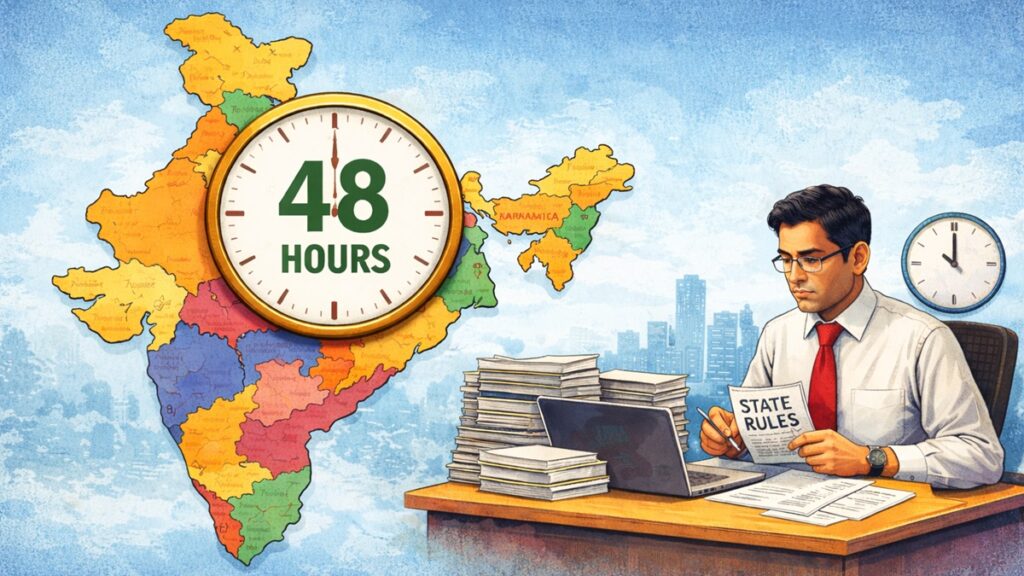
But the loudest debates often skip the quietest problem: India doesn’t have one working-hours law. It has dozens. And somewhere in that maze of state-level rules, sector-specific exemptions, and half-implemented national codes, HR teams are trying to build compliant, functional workplace policies.
That balancing act is getting harder, not easier.
A National Debate Without a National Rule
India’s conversation about working hours has intensified in recent years, driven by competing forces: calls for global competitiveness from industry leaders on one side, and growing employee burnout and work-life balance concerns on the other.
But unlike countries such as Germany, France, or even neighbouring Sri Lanka, which operate with relatively uniform national working-hour regulations, India’s working hours are governed by multiple laws and state-level regulations, creating a fragmented policy landscape where each state or city sets its own rules on maximum daily hours, rest intervals, and overtime.
The result is a country where two employees doing identical jobs for the same company, one in Chennai, one in Bengaluru, may be working under meaningfully different legal frameworks. For HR teams managing multi-state workforces, that’s not a theoretical inconvenience. It’s a daily operational reality.
The Baseline: What National Labour Laws Say
Before the state-level picture, India has a broad national framework worth understanding.
The Factories Act, 1948, which applies primarily to the manufacturing sector, sets the following limits:
- Maximum 9 hours per day
- Maximum 48 hours per week
- A 30-minute break after every 5 hours of continuous work
- Overtime paid at double the wage rate
The Occupational Safety, Health and Working Conditions (OSH) Code largely preserves this 48-hour weekly cap, with regular working hours limited to 8 hours a day and 48 hours a week, a compulsory weekly day of rest, and overtime paid at twice the ordinary wage rate.
The OSH Code also allows some flexibility in how hours are distributed across days — opening the door to compressed workweeks in theory, though implementation depends heavily on state rules.
Here’s the critical caveat: for most white-collar and service sector employees, the bulk of India’s growing organised workforce, the Factories Act doesn’t apply. Their hours are governed by state-specific Shops and Establishments Acts. And that’s precisely where the patchwork begins.
How State Laws Create Different Working Hour Rules
Most states converge on the 48-hour weekly cap. After that, the similarities thin out. Daily limits, spread-over periods, overtime caps, and break requirements differ enough to create real compliance complexity.
Most states also require one mandatory weekly day off, a rest break after every 4–5 hours of continuous work, and overtime paid at twice the standard wage rate.
The “spread-over” distinction is worth pausing on. A 12-hour spread-over in Bengaluru doesn’t mean 12 hours of work; it means an employee’s working day, including breaks, can extend across a 12-hour window.
But that still affects shift scheduling, transport arrangements, canteen obligations, and fatigue-related wellbeing policies. A uniform national shift schedule that’s compliant in Delhi may be non-compliant in Chennai, where the daily cap sits at 8 hours, not 9.
States Experimenting With Longer Shifts
The 48-hour weekly cap may be holding firm, but everything beneath it, how those hours are distributed, how long a single shift can run, how much overtime is permissible per quarter, has been shifting rapidly.
Since 2023, at least six states have amended their factory and commercial establishment laws to allow longer daily shifts and higher overtime ceilings. The framing is consistent across all of them: ease of doing business, investment attraction, and economic growth. The ground-level implications for workers and HR teams are considerably more complicated.
Karnataka: The Amendment That Started the Cascade
Karnataka’s The Factories (Karnataka Amendment) Bill, 2023, empowered the state government to increase the daily working hour limit to 12 hours (inclusive of rest intervals), while maintaining the 48-hour weekly cap.
The quarterly overtime limit was raised from 75 hours to 145 hours. The bill passed both legislative houses, without floor debate in the assembly, and received Presidential assent in July 2023.
The amendment was widely reported to reflect lobbying by Apple and Foxconn, both of which have supply chain interests in the state. Karnataka’s Law Minister J.C. Madhu Swamy pushed back on that framing, saying the “amended law did not impose 12-hour workdays or make it compulsory for industries, it is meant to facilitate agreements between industry and labour.”
However, by mid-2024, Karnataka’s Labour Minister Santosh Lad was publicly acknowledging pressure from global capability centres and manufacturers to push even further, to a 14-hour working day for IT/ITeS employees.
“Obviously, since the pressure is from the industry, the bill has come to us. We are still evaluating this from the labour department. I want all the heads of industries to discuss this since it is now an open demand,” Lad told reporters.
In June 2025, the Karnataka government proposed an amendment to the Karnataka Shops and Commercial Establishments Act, 1961, to extend the legal maximum number of working hours in a day from 9 to 10.
Other changes within the proposal include raising overtime limits, along with simplifying record-keeping and compliance for small businesses.
Gujarat: Two Laws, One Year, One Compliance Puzzle
Gujarat has amended two separate legislative frameworks within twelve months, one for factories, one for commercial establishments, making it the most active state on working-hours reform in this cycle.
The factory round came first. The Factories (Gujarat Amendment) Bill, 2025, allowed 12-hour shifts (inclusive of breaks), enabling workers to complete their 48-hour weekly quota in four days, with the remaining days as paid leave.
The commercial establishments round followed in early 2026. The Gujarat Shops and Establishments (Amendment) Bill, 2026, was passed unanimously on February 17, 2026, replacing an ordinance from December 2025.
Daily hours in shops rose from 9 to 10; quarterly overtime from 125 to 144 hours; the applicability threshold from 10 to 20 employees. Women can now work nights between 9 PM and 6 AM, two hours later than the factory window, with mandatory transport, crèche facilities, and documented consent.
Labour Minister Kunvarji Bavaliya, introducing the bill, said the changes were meant “to balance the interests of workers, traders, employers, and the wider public” and assured the House that “no relaxation would be granted” on enforcement. On women’s safety, he added that “The State Government has made complete provisions in the Act to maintain the dignity, security, and safety of women at the workplace.”
The compliance math, though, is trickier than the political messaging. A 10-hour workday over five days yields 50 weekly hours, exceeding the 48-hour cap and automatically triggering overtime that many employers may not have anticipated.
Legal analysts have also flagged a potential conflict with the OSH Code, now in force since November 2025, which specifies 8 hours as the standard daily working period.
Haryana: Setting a National Record on Overtime
Haryana’s Vidhan Sabha passed the Haryana Shops and Commercial Establishments (Amendment) Bill, 2025, in December 2025. The bill increases daily working hours from 9 to 10 hours, within the 48-hour weekly cap, and raises the quarterly overtime limit to 156 hours, the highest in the country.
Labour Minister Anil Vij, introducing the bill, framed it as alignment rather than escalation. “This measure aims to create greater economic activity, enhance employment opportunities, and give establishments the flexibility to handle emergencies, peak demand, or staff shortages without disruption,” he said.
Vij noted that 10-hour daily limits already existed in Maharashtra, Punjab, Telangana, Andhra Pradesh, and Odisha and that Haryana was simply catching up. The bill was passed by voice vote.
Andhra Pradesh: IT-Specific Flexibility
Andhra Pradesh took a more targeted approach. The state extended its overtime exemption for IT and ITeS firms as of March 2025, preserving the standard 48-hour weekly limit while giving the sector-specific flexibility in how those hours are structured.
Rather than a blanket extension of daily limits, Andhra Pradesh created an industry-specific carve-out, adding a compliance layer for multi-state IT employers who now need to account for sector-based variations within individual states.
“Section 54, which allows maximum nine hours of work a day, has now been raised to 10 hours per day. Under Section 55, there used to be one hour rest for five hours (work), now that has been changed to six hours,” Information and Public Relations (I&PR) Minister Kolusu Parthasarathy explained.
Tamil Nadu: Reform Attempted, Then Reversed
In April 2023, the Tamil Nadu assembly passed the Factories Amendment Act, which would have allowed workers to work 12-hour days, resulting in an extra weekly day off within the 48-hour cap.
Following protests by trade unions and opposition parties, Chief Minister MK Stalin’s government was forced to abandon the reform. Tamil Nadu’s reversal demonstrated that the political economy of these amendments isn’t uniform; the same argument for compressed workweek flexibility that passed in Gujarat can fail in a state with stronger union mobilisation.
Operational Flexibility vs Worker Protection
State-level reforms in this space typically focus on three things: enabling 24/7 business operations, permitting night shifts for women with safety provisions, and allowing compressed workweeks or extended daily shifts.
Maharashtra, for instance, allows shops to operate 24×7, but employees must still receive a mandatory weekly day off and cannot individually be made to work more than the stipulated hours. Business operating hours and employee working hours are increasingly decoupled, complicating HR scheduling in ways older frameworks weren’t designed to handle.
The tension here is real. For employers, flexibility enables them to match staffing with demand cycles, reduce real estate costs through shift-based office use, and compete in global markets that don’t observe Indian time zones. For workers, longer daily shifts, even with weekly caps, compress rest time, increase commute burden, and can erode the informal buffer that shorter days provide.
Neither concern is wrong. But they pull in opposite directions, and HR sits at the intersection.
Why This Patchwork Creates Problems for HR
For companies operating across multiple states, the compliance complexity isn’t abstract — it translates into specific operational headaches.
- Compliance complexity: Each office must follow local state rules, even within the same company. A shift policy designed at HQ in Mumbai may require legal review before being applied in Hyderabad or Kolkata.
- Policy standardisation: A uniform national HR policy on working hours, overtime eligibility, and shift scheduling may simply not be legally applicable everywhere. HR teams often end up maintaining state-specific addenda to what should be standard documents.
- Payroll and overtime management: Different overtime caps, quarterly hour limits, and daily spread-over rules require customised payroll logic per state. Penalties for non-compliance with the new Labour Codes range from ₹50,000 to ₹1,00,000 and may include imprisonment, depending on the nature of the violation. This means getting the configuration wrong isn’t just an administrative slip.
A mid-sized IT services company with offices in Delhi, Bengaluru, and Chennai is, in effect, operating under three different labour regimes for the same employee category. The spreadsheets multiply. The legal reviews compound. And the person responsible for making it all coherent is almost always in HR.
The Employee Perspective
Workers aren’t passive observers in this debate. They have sharp and increasingly public views.
In India’s IT sector specifically, a Blind survey of 1,450 verified IT professionals conducted in March 2025 found that 72% routinely exceed the legal 48-hour limit, 25% clock more than 70 hours per week, and 83% report experiencing burnout.
A separate survey found that 62% of Indian employees experience burnout, three times the global average of 20%.
Employee concerns cluster around three areas: physical and mental health fallout from sustained overwork, a work culture that informally penalises those who leave on time, and unclear or unenforced overtime rules that leave workers absorbing extra hours without compensation.
The gap between what the law says (48 hours) and what the culture normalises (significantly more) is where employee dissatisfaction quietly compounds.
The Labour Codes Question
India’s four Labour Codes were supposed to resolve much of this. The promise was to consolidate 29 central labour laws into a cleaner, more navigable framework that would simplify compliance for employers and expand protections for workers.
On November 21, 2025, India officially implemented the four Labour Codes — the Code on Wages 2019, the Industrial Relations Code 2020, the Code on Social Security 2020, and the OSHWC Code 2020, replacing 29 older laws.
But the reality of implementation is more complicated than the notification date suggests. The corresponding Central and State rules, schemes, and digital compliance infrastructure remain pending. Employers are experiencing a dual-compliance environment in which legacy state legislation continues to apply until superseded.
Crucially, the OSH Code does not subsume local Shops and Establishments legislation, which remains in force and must be read harmoniously with the Codes. Which means the state-level patchwork on working hours, the core of the problem, remains largely intact even after the landmark November 2025 implementation.
As of the most recent Ministry of Labour reporting, 34 states and union territories have released draft rules for the Wage Code; 32 for both the Industrial Relations Code and the Social Security Code; and 33 for the OSHWC Code. Draft rules are not final rules. And until they are, HR teams can’t fully operationalise the new framework.
Why HR Leaders Want Clarity
Most HR leaders aren’t lobbying for longer workweeks or shorter ones. The ask is far more practical.
They want a consistent interpretation of Labour Codes across states so that a compliance decision made in one jurisdiction can reasonably inform decisions in others. They want clear national guidelines that don’t require a law firm on retainer for every new office location. And they want predictable compliance timelines so HR policy reviews aren’t perpetually deferred while waiting for the next state notification.
In December 2024, the Ministry of Labour announced reforms to streamline Labour Code processes, including simplified, single-window registration and filing systems and a firm-based common licence with a five-year validity. That’s directionally right. But single-window registration doesn’t solve the underlying question of whose working-hours rules apply where.
Until there’s coherence on that question, HR will keep building bespoke policy riders for each state, maintaining parallel payroll configurations, and explaining to employees why the same company has different shift norms depending on which city you sit in.
In the End…
India’s working-hours debate will continue. The productivity argument isn’t going away. Neither is employee burnout data, nor is it the growing chorus of workers. especially younger ones, who refuse to treat overwork as a virtue.
But the structural problem underneath is regulatory fragmentation. With different states experimenting with different rules, companies trying to build compliant national policies are navigating a moving target. The Labour Codes were meant to resolve that. The notification happened. The resolution is still pending.
Until the state-level picture catches up, HR teams remain the ones doing the interpretive work, translating overlapping regulations into everyday shift schedules, payroll calculations, and employment contracts. Not because they’re uniquely equipped for it, but because someone has to. And in most Indian organisations, that someone is a person who wears an HR badge.
The debate about how many hours Indians should work is important. The quieter question, about whether the rules governing those hours are even consistent enough to enforce, might matter more.
FAQs
What is the legal maximum working hours limit in India?
Under the Factories Act, 1948 and the OSH Code 2020, the standard limit is 48 hours per week and 8–9 hours per day. Overtime must be paid at twice the ordinary wage rate.
Do working hour rules differ from state to state in India?
Yes. While most states follow the 48-hour weekly cap, daily limits, overtime ceilings, and spread-over periods vary significantly under each state’s Shops and Establishments Act.
Which states have recently changed their working hour rules?
Karnataka, Gujarat, Haryana, and Andhra Pradesh have all amended their working hour regulations since 2023, primarily raising daily limits to 10–12 hours and increasing quarterly overtime caps.
Does the OSH Code 2020 replace state Shops and Establishments Acts?
No. The OSH Code does not subsume state Shops and Establishments legislation. Both apply simultaneously, which means HR teams must comply with both frameworks until states fully align their rules.
What are the penalties for violating working hour rules under the Labour Codes?
Penalties range from ₹50,000 to ₹1,00,000 and can include imprisonment, depending on the nature of the violation.
Can employees be required to work 12-hour shifts in India?
In states like Karnataka and Gujarat, 12-hour shifts are now legally permissible for factories, provided the 48-hour weekly cap is maintained. However, this is not a blanket national rule.
What is a “spread-over” in Indian labour law?
Spread-over refers to the total window of a working day, including breaks. In Bengaluru, for example, the spread-over can extend to 12 hours. This means that an employee’s day can span 12 hours, even if actual work time is less.
Are IT companies subject to the same working hour rules as factories?
No. IT and ITeS companies are primarily governed by state Shops and Establishments Acts, not the Factories Act. Some states, like Andhra Pradesh, have created IT-specific overtime exemptions.