
The Sexual Harassment of Women at Workplace (Prevention, Prohibition and Redressal) Act, 2013, protects only women. Men, transgender employees, and non-binary employees fall outside its statutory pathway, and India’s Supreme Court has twice declined to widen that definition, most recently in November 2023, when it refused to replace “aggrieved woman” with “aggrieved persons” in the Gender Sensitisation Regulations of the Supreme Court itself.
That refusal has not stopped employers from moving on their own. A growing list of Indian companies, from old conglomerates to IT majors, have written gender-neutral anti-harassment policies into their internal rule books, even though the law does not require it. This piece looks at why companies are doing this, who is doing it, and what a gender-neutral policy actually changes on the ground.
What Gender-Neutral Actually Means In This Context
A gender-neutral harassment policy is a company-level document that allows any employee, regardless of gender, to file a harassment complaint and have it heard through a structured process. It does not replace the POSH Act. It sits alongside it.
Under the POSH Act, only a woman can file as the “aggrieved person,” and the Internal Committee has jurisdiction only over her complaint. A man or a transgender employee who experiences harassment has no statutory IC route. A gender-neutral company policy fills that specific gap by extending POSH-style protection- often the same committee, the same timelines, the same confidentiality- to everyone else.
A few legal anchors make this workable:
- Article 14, 15, and 21 of the Constitution are commonly cited as the basis for voluntary gender-neutral policies, since equal protection and dignity apply regardless of POSH’s statutory scope.
- Section 18 of the POSH Act, which governs appeals, already uses “any person,” meaning a respondent of any gender can appeal an IC decision.
- The Malabika Bhattacharjee ruling (Calcutta High Court, 2021) held that nothing in Section 9 of the Act precludes a same-gender complaint, since a woman can be harassed by another woman. This widened the Act’s practical reach without touching its gender-specific wording.
- The Transgender Persons (Protection of Rights) Act, 2019 requires organisations to appoint a Complaints Officer for harassment or discrimination faced by transgender employees, a separate statutory route that gender-neutral company policies often fold into one combined mechanism.
Why The Law Stops At Women
The POSH Act traces back to the 1992 gang-rape of Bhanwari Devi, a Rajasthan government social worker, and the 1997 Vishaka guidelines that followed. It was written, deliberately, to protect women in a workplace structure where men held most positions of power. Supporters of keeping it that way argue that broadening the law risks diluting protections for women, who still make up the overwhelming majority of substantiated harassment cases.
The Supreme Court made this argument explicit in its November 2023 order. It held that making POSH-style protections gender-neutral would shift focus away from the Act’s founding purpose, protecting women, and that any expanded protection for other genders would need a separate framework rather than a rewrite of POSH itself.
That leaves a real coverage gap. Recent India-specific data shows it isn’t theoretical:
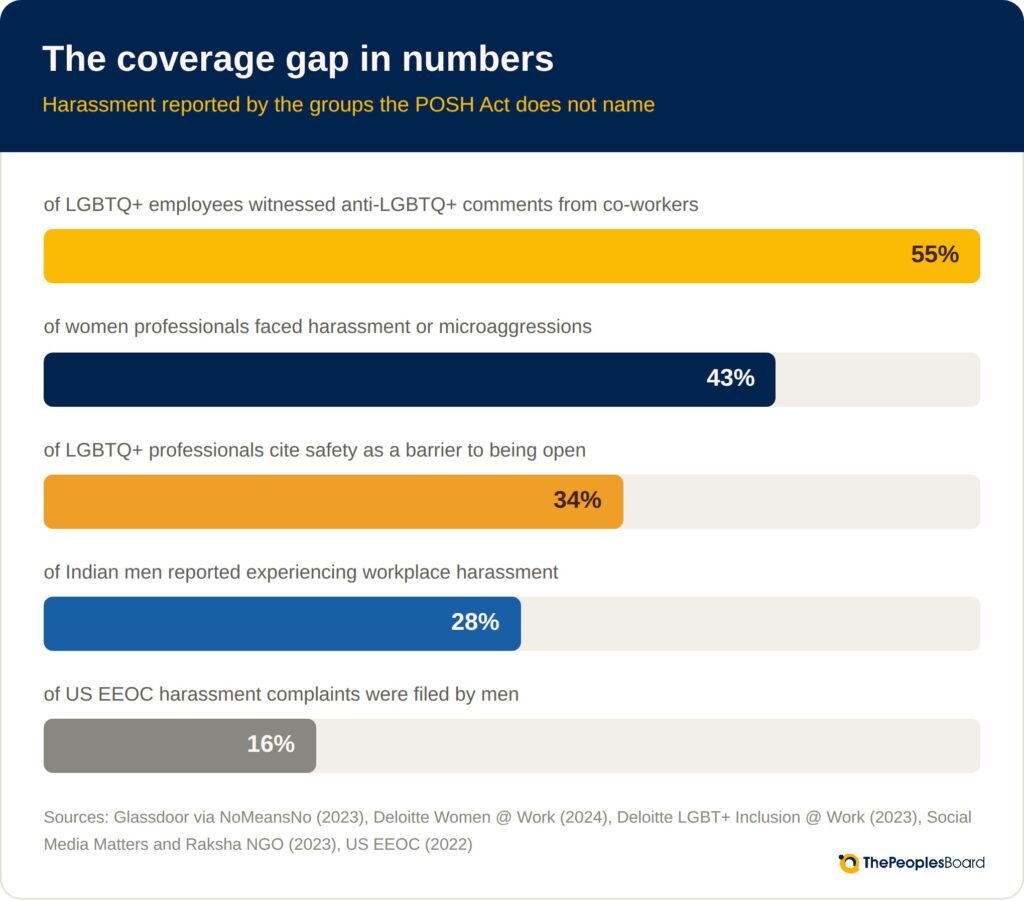
None of these numbers run through a statutory POSH channel for men or LGBTQ+ employees in India. They surface, if at all, through general grievance redressal, performance conversations relabelled as “conduct issues,” or not at all.
Which Indian Companies Have Adopted Gender-Neutral Policies
Several large Indian and India-operating companies have built gender-neutral anti-harassment frameworks into their HR policy stack, ahead of any legal mandate to do so.
| Company | What The Policy Covers |
| Godrej Industries | Gender Neutral Anti-Sexual Harassment policy, plus a Gender Affirmation Policy and Gender Transition Guidelines for employees transitioning |
| Wipro | Gender-neutral sexual harassment policy and committee applying to all employees, with same-gender complaint pathways |
| Infosys | Gender-neutral sexual harassment policy and committee structure that conducts unbiased inquiry regardless of the complainant’s or respondent’s gender |
| Taj Group of Hotels | Gender-neutral sexual harassment policy and committee, applicable across all employees |
| OYO Rooms | POSH committee trained to handle complaints involving any gender, including same-gender cases |
| Procter & Gamble India | Gender-neutral infrastructure and sensitisation programs tied to its broader allyship and inclusion framework |
Godrej’s policy has been publicly described by its own leadership. Shefali Kohli, Group Head, Strategic Rewards and People Process at Godrej Industries, said the company has “implemented several measures to create a welcoming workplace for our queer employees,” including a “Gender Affirmation Policy and Gender Transition Guidelines” alongside a “Gender Neutral Anti-Sexual Harassment policy.”
This pattern is not new. Reporting goes back to 2018, after the Supreme Court read down Section 377 of the IPC, already naming Godrej, Tata, Infosys, and The Lalit Suri Hospitality Group among the early movers, alongside global firms operating India offices such as Bain & Company, KPMG, Accenture, and Adobe.
How These Policies Differ From Statutory POSH
A gender-neutral company policy is not simply POSH with the word “woman” deleted. The practical design choices vary, and they matter for how the policy actually functions during a complaint.
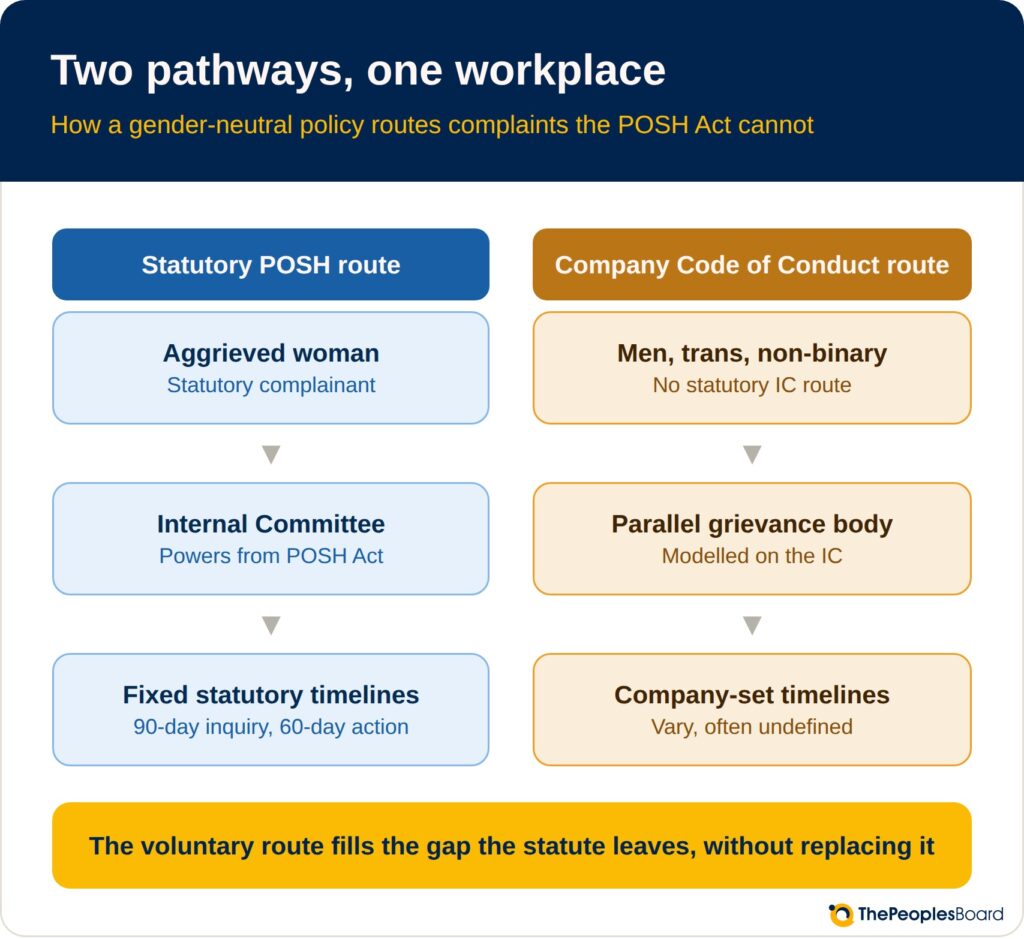
- Jurisdiction split: Many companies route women’s complaints through the statutory IC, since that committee’s powers come directly from the POSH Act, while complaints from men or third-gender employees go through a parallel grievance mechanism modelled on the IC but operating under the company’s own Code of Conduct, not POSH itself. This distinction matters because an IC’s statutory powers, summons, recommendation enforceability within 60 days, do not automatically extend to a non-POSH complaint.
- Terminology changes: Several companies, including Godrej, have replaced “spouse” or “husband/wife” with “partner” across HR documentation, extending benefits like medical cover and same-sex partner recognition without waiting for insurance regulation to catch up.
- Insurance workarounds: Indian insurers historically did not recognise same-sex domestic partnerships. Companies like The Lalit negotiated directly with Indian providers to cover LGBTQ+ employees’ families, including children born through surrogacy, while others bought policies from global insurers that already recognised civil unions.
- Composition of the committee: Diversity and inclusion practitioners recommend mixed-gender, mixed-orientation panels for any harassment inquiry under a gender-neutral framework, on the reasoning that fairness in investigations depends on the panel itself not skewing toward one gender’s lived experience.
- Physical and digital signals: Gender-neutral washrooms, inclusive job posting language, and updated offer letter wording around conduct standards are frequently bundled with the policy rollout rather than treated as a separate DEI initiative. TPB’s coverage of offer letter requirements under India’s new labour codes notes that conduct clauses increasingly need to account for this broader framework, not just POSH.
What Companies Risk Getting Wrong
A gender-neutral policy on paper does not automatically translate into a functioning one. The same structural failures that show up in standard POSH compliance, documented at length in TPB’s analysis of why POSH complaints in India are still under-reported, apply with equal or greater force to gender-neutral channels, since there is less institutional muscle memory and far less public scrutiny.
Common failure points include:
- No statutory backstop: A POSH complaint from a woman has a 90-day inquiry window and a 60-day action window under Sections 13 and 14 of the Act. A gender-neutral complaint from a man, sitting outside POSH, has no equivalent legal deadline unless the company writes one into its own Code of Conduct, and many don’t.
- Stigma suppresses reporting more than the law does: Surveys cited by Legal India found that more than half of young professionals who experienced harassment never filed a formal complaint, and that gap widens further for men, who often avoid reporting out of fear of being mocked rather than believed.
- Committees built for one type of case: An IC trained exclusively on POSH scenarios involving a male respondent and a female complainant may have no protocol for a same-gender complaint or a complaint from a man, even when the company’s own policy technically allows for it.
- Disclosure asymmetry: The Companies (Accounts) Second Amendment Rules, 2025, effective from 14 July 2025, now require companies to disclose POSH complaint numbers and workforce gender composition, including transgender employee counts, in their Board Reports. Gender-neutral complaints outside the POSH framework carry no equivalent public disclosure requirement, which means there is currently no way to verify, from outside the company, whether these parallel mechanisms are actually being used.
A Quick Comparison
| Feature | POSH Act (Statutory) | Voluntary Gender-Neutral Policy |
| Who can file | Aggrieved woman only | Any employee, depending on company design |
| Legal mandate | Mandatory for workplaces with 10+ employees | Voluntary, no statutory requirement |
| Inquiry timeline | 90 days, extendable, under Section 11 | Set by company policy, varies widely |
| Action timeline | 60 days under Section 13 | Set by company policy, varies widely |
| Public disclosure | Required in Board Reports under MCA rules since July 2025 | No standard disclosure requirement |
| Appeal route | Section 18, open to “any person” | Typically mirrors internal grievance appeal process |
What HR Teams Can Actually Do Without Waiting For The Law
Companies don’t need legislative change to close most of this gap. The pattern among early movers points to a few concrete, low-cost steps:
- Write a standalone gender-neutral harassment clause into the employee handbook or Code of Conduct, separate from the POSH policy, so it doesn’t get legally conflated with statutory obligations.
- Define inquiry and action timelines for non-POSH complaints explicitly, rather than leaving them open-ended.
- Train the existing Internal Committee, or a parallel committee, on same-gender and male-complainant scenarios specifically, not as an afterthought to standard POSH training.
- Update partner, spouse, and family terminology across HR documents, benefits forms, and offer letters.
- Track and report gender-neutral complaint volumes internally, even without a public disclosure mandate, since unmeasured channels tend to stay unused.
In the End…
The POSH Act was written to fix a specific, urgent gap: the absence of any legal protection for women in Indian workplaces. It still does that job, and the Supreme Court has been deliberate about not diluting that focus. But workplaces have moved faster than the statute on a separate question: what happens to everyone the Act doesn’t name. Godrej, Wipro, Infosys, Taj Group, and a growing list of others have answered that question internally, well ahead of any legal requirement to do so.
The next test for these voluntary policies isn’t whether they exist on paper. It’s whether the complaint actually gets heard, acted on, and counted, the same three things that statutory POSH compliance is still struggling with a decade after the law came into force.
FAQs
Does the POSH Act cover men and transgender employees?
No. The POSH Act, 2013 protects only women, who alone can file as the aggrieved person before an Internal Committee. Men, transgender, and non-binary employees have no statutory IC route. India’s Supreme Court declined to widen this definition in November 2023, holding that any expanded protection for other genders needs a separate framework rather than a rewrite of POSH.
What is a gender-neutral workplace harassment policy?
It is a company-level policy that lets any employee, regardless of gender, file a harassment complaint and have it heard through a structured process. It does not replace the POSH Act. It sits alongside it, extending POSH-style protection, often the same committee, timelines, and confidentiality, to everyone the statute does not name.
Which Indian companies have adopted gender-neutral harassment policies?
Godrej Industries, Wipro, Infosys, Taj Group of Hotels, OYO Rooms, and Procter & Gamble India are among the firms that have built gender-neutral anti-harassment frameworks. Godrej also runs a Gender Affirmation Policy and Gender Transition Guidelines. Early movers named since 2018 include Tata, The Lalit Suri Hospitality Group, Bain & Company, KPMG, Accenture, and Adobe.
Can a woman file a harassment complaint against another woman under the POSH Act?
Yes. The Calcutta High Court held in the Malabika Bhattacharjee ruling (2021) that nothing in Section 9 of the Act precludes a same-gender complaint, since a woman can be harassed by another woman. This widened the Act’s practical reach without changing its gender-specific wording.
How is a gender-neutral company policy different from the statutory POSH Act?
The POSH Act is mandatory for workplaces with 10+ employees, sets a 90-day inquiry window and a 60-day action window, and requires complaint disclosure in Board Reports under MCA rules since July 2025. A voluntary gender-neutral policy is not legally required, sets its own timelines that vary widely, and carries no standard public disclosure requirement.
Do gender-neutral harassment complaints have legal deadlines?
Not automatically. A POSH complaint from a woman has statutory 90-day inquiry and 60-day action windows under the Act. A gender-neutral complaint sitting outside POSH has no equivalent legal deadline unless the company writes one into its own Code of Conduct, and many do not.