

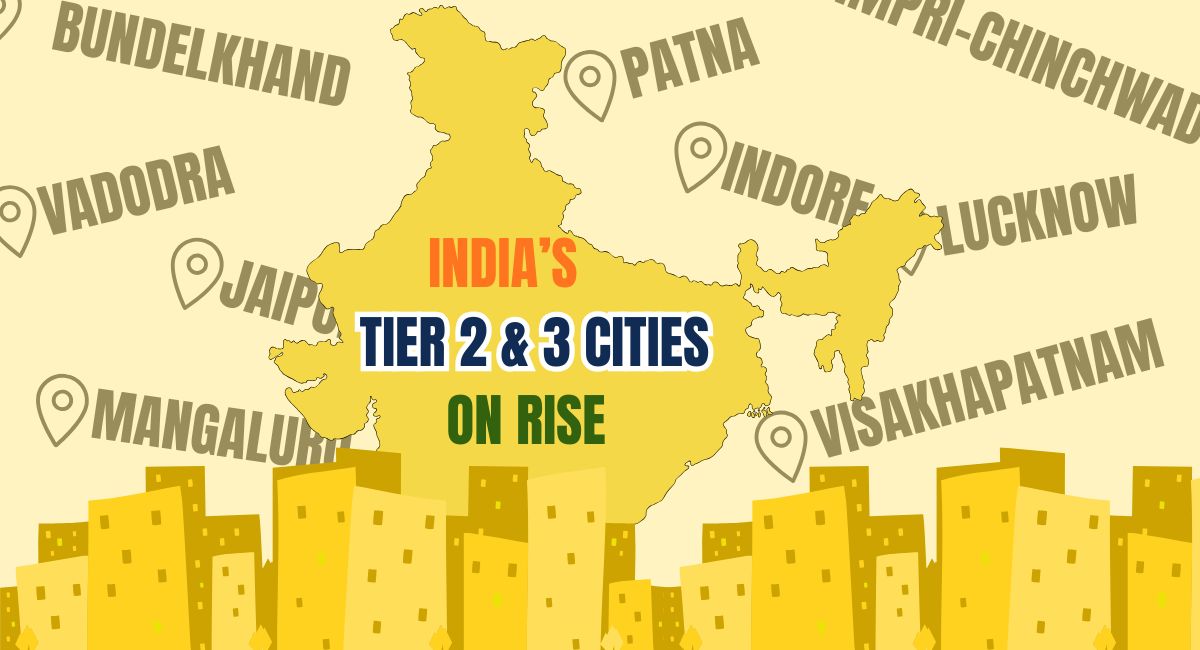

Over the past few months, companies across India, both big and small, have been making many efforts to expand into tier 2 and tier 3 cities within India. An initiative supported by both the union and state governments.
There has been a growing recognition of the fact that talent within India is not limited to metro cities. Thanks to technological advancements and developing infrastructure, many smaller cities in India are emerging as prominent talent hubs.
Needless to say, many companies are now modifying their talent strategies to inculcate candidates from tier 2 and tier 3 cities. From multinational companies opening new branches to gig work platforms providing employment opportunities, tier 2 and tier 3 cities have become a goldmine ripe for digging.
Why the Shift Beyond Metros Is Happening
The shift of companies from metros like Delhi and Bengaluru to tier 2 and tier 3 cities is becoming more and more popular due to a multitude of factors. While some of these reasons can be linked to simple efficiency, others are a result of changing workplaces and mindsets.
Lower Hiring Costs, Reduced Attrition and Wider Talent Pools
As per NLB’s “Workforce 2.0 Reset – India’s GCCs Go AI-Native” report, GCCs are gaining prominence in tier 2 and tier 3 cities, with many set to capitalise on the proposition of 10–12% lower attrition rates, 30–50% lower office costs, and 20–35% talent cost advantages compared to Tier 1 metros.
Hiring in tier 2 and tier 3 cities can often be less costly than metro recruitment. A lower cost of living and cheaper office rentals, combined with lower salary expectations has led many companies to shift to tier 2 and tier 3 cities to save costs.
Providing jobs in tier 2 and tier 3 cities to locally based talent also leads to lower attrition. Nearly 30% of India’s graduates come from outside metro regions. Having job opportunities closer to home leads to longer retention in a company.
Moreover, by not restricting themselves to employees based only in metro cities, companies are able to access a wider talent pool, not feeling as if relocation or geographical distance might become a deal breaker.
Digital and Physical Infrastructure
Thanks to various government and private initiatives, digital and physical infrastructure across tier 2 and tier 3 cities is developing at a rapid pace. With greater internet access and faster transport, opportunities in these areas are increasing by the day.
The government has taken various initiatives to improve the digital infrastructure of tier 2 and tier 3 cities, including the India Business Process Outsourcing Promotion Scheme (IBPS) and North East Business Process Outsourcing Promotion Scheme (NEBPS).
The aim of these schemes is to create employment opportunities and the dispersal of IT and IT-enabled services by setting up 246 units in 104 small cities/towns. Additionally, the government also shared its plan in July 2025 to set up 59 centres in tier 2 and tier 3 cities under the Software Technology Parks of India initiative.
Mainstream Hybrid/Remote Work Models
Thanks to the widespread usage of hybrid/remote work models, companies are now able to provide positions to employees, no matter their location. With a focus only on what a candidate can provide to the company, the quality of work is bound to increase with each hire.
These advantages are not just limited to tier 2 and tier 3 cities but to candidates based in any location with an adequate internet connection and required qualifications. Such work models have made work more accessible and accommodating for those who might have previously been restricted in employment opportunities owing to geographical and personal factors.
Employer Brand & Inclusive Workforce Strategy
Hiring across the nation and not being restructured to metro boundaries can strongly strengthen the employer brand of a company. It also brings about diversity within the workforce that represents India as its most inclusive.
Tier 2 and tier 3 cities also pave the path for providing opportunities for first-generation professionals, underrepresented groups, and women. By emphasising skill-first, location-agnostic companies can easily broaden talent pipelines, uplift different communities, and create a strong image within the market.
Challenges & How Organisations Are Solving Them
Expanding to tier 2 and tier 3 cities is not without its challenges. From necessary skills to expected infrastructure, there is still much that is stopping companies from tapping into the potential within regions.
Skill Gaps & Training Needs
For many companies, being based completely in tier 2 and tier 3 cities can lead to skill gaps and increased training needs amongst the workforce. However, with the right supervision and calculated training regimes, companies can help their employees upskill in a way that benefits the company in more ways than one.
Such programs can also help bridge the industry-education divide, creating a locally based, specialised, and engaged workforce. Companies can also partner with local institutes and online training programs to upskill their employees as needed.
Leadership & Manager Readiness
As companies open up branches in tier 2 and tier 3 cities, managers and others in leadership can find it difficult to effectively manage a widespread workforce. Furthermore, the needs of an employee based in a metro city can be vastly different from those of one based in a tier 2 or tier 3 city.
To improve the leadership capabilities of those in senior roles, companies can organise leadership workshops. Additionally, team-building sessions that include employees from various geographic locations can help managers better understand employees’ needs, while workers will become more relaxed with their colleagues.
Government Initiatives Fueling Job Growth
Over the years, India’s state and central governments have launched various initiatives to make tier 2 and tier 3 cities more attractive to employers. Such initiatives include infrastructure development, financial incentives, and upskilling opportunities for locals.
UP’s Bids for GCCs
In January 2026, the Uttar Pradesh government notified detailed standard operating procedures (SOPs) providing front-end land subsidies to eligible units in order to position the state as a preferred location for Global Capability Centres (GCCs).
GCC units established in Purvanchal and Bundelkhand will receive a 50% subsidy on land purchased from government agencies. The framework will also allow GCCs setting up units in the Paschimanchal (excluding Gautam Budh Nagar and Ghaziabad) and the Madhyanchal region to receive a 40% subsidy. Those setting up operations in Gautam Budh Nagar and Ghaziabad will be eligible for a 30% subsidy.
Beyond Bengaluru Initiative
Karnataka’s “Beyond Bengaluru” initiative generated nearly 5,600 jobs between 2021-2022 and 2024-2025, as per data from Karnataka Digital Economy Mission (KDEM). The initiative seeks to expand employment opportunities outside the tech hub of Bengaluru and create more opportunities for locals.
Out of the 126 companies that opened in Hubballi-Dharwad, Mangaluru, and Mysuru clusters, 51 were launched in 2024-2025 itself. These new firms alone created 1,500 jobs.
Telangana’s Push
In November 2024, IT and industries minister D Sridhar Babu shared how the Telangana government is trying to convince big players like HCL and GlobalLogic to go to smaller cities with available talent.
The minister talked about how he wants companies to see beyond the city’s shining example of Hyderabad to look into tier 2 and tier 3 cities like Nizamabad, Karimnagar, Siddipet, Adilabad, and even Mancherial and Ramagundam “The primary objective is to provide youth in Telangana employment at their doorsteps,” Babu explained.
Women’s Empowerment in Bihar
The Bihar government launched the Mukhyamantri Mahila Rojgar Yojana that promises financial support of up to ₹2 lakhs for aspiring women entrepreneurs. The first phase of the scheme had provided support of up to ₹10,000.
Women between the ages of 18 and 60 are eligible for the initiative, and they, or their husband, cannot be income tax payers. Before the entrepreneurs receive the promised ₹2 lakhs, they will be given training regarding technology, market trends, and business basics.
Corporate Moves Driving Regional Talent Engagement
Many companies have taken steps to establish a strong presence in tier 2 and tier 3 cities before most. From creating new offices to seasonal employment, these companies have done much to bolster the economy of the region and pave path for future employers.
Shifting Focus to New Locations
Many companies have openly announced their intent to expand to tier 2 and tier 3 cities. In September 2025, Oracle talked about opening a branch in every state capital and discovering new talent.
“We have decentralised our operations in India and are opening more offices in small cities. We are also hiring more from tier-II and tier-III cities and giving flexibility to our employees to work from home, while offering them the same benefits,” Sanjeev Chauhan, Oracle India’s Vice President – Solution Engineering, shared.
Similarly, Radisson Hotel Group has set a target of 500 hotels and 50,000 employees in India by 2030. Elie Younes, Executive Vice President and Global Chief Development Officer of the Radisson Hotel Group, believes the next phase of the company’s growth in India will come from tier-II to tier-IV cities.
Initiatives in Indore
As part of its DTDC Raftaar rapid commerce network, DTDC Express launched an all-women-operated dark store in Indore. The facility was deemed by Abhishek Chakraborty, CEO, DTDC, as the ‘Dream Store’ that combines the company’s focus on women’s inclusivity as well as the drive to expand to meet the increasing demands in tier 2 and tier 3 cities.
Indore also saw the opening of a new IT Services (ITS) centre by DHL Group in September 2025. The centre boosted DHL ITS to nearly 6,000 strong globally, with 1,300 employees in India itself.
Expansion of Visakhapatnam
In June 2025, Cognizant shared its plans to build a new campus in the city of Vishakapatanam. By investing ₹15.82 billion, the company plans to create over 8,000 jobs in the region. The commercial operations of the campus is expected to begin in operations will begin in March 2029.
Previously, in April 2025, Tata Consultancy Services (TCS) was allotted 21.16 acres of land for a symbolic lease price of 99 paisa per acre. As per Minister for IT and Electronics, Nara Lokesh Naidu, TCS will invest ₹1,370 crore in a development centre that is set to create around 12,000 jobs.
E-commerce Seasonal Hiring
During the festive season, e-commerce platforms like Flipkart, Amazon, and Meesho led to a significant boost in employment within tier 2 and tier 3 cities. Flipkart, in particular, opened up 650 new festive season exclusive delivery hubs in tier 2 and tier 3 cities.
Flipkart also shared its plans to expand its last-mile reach and inclusive hiring in tier 2 and tier 3 cities, including Siliguri, Kundli, Jakhar, and many more. Similarly, Meesho created nearly 12 lakh seasonal jobs, over 70% of which were expectedly filled from India’s tier-3 and tier-4 regions. Amazon’s recruitment drive for the festive season also spanned over 400 cities, including metro and beyond.
Platform Innovation for Local Jobs
Startups like Lokal are launching Sahi Jobs, a verified job marketplace for blue- and grey-collar workers in tier 2 and tier 3 cities to support hiring in the region. The platform was created to provide authentic job opportunities to locally based employees while combating scams and unsuitable roles.
In the End…
Expansion into tier 2 and tier 3 cities across India paints a hopeful picture for both employers and employees. Deloitte’s South Asia CEO, Romal Shetty, shared how the company plans on hiring 50,000 new employees in India, with an eye on expanding in Mangaluru.
“India is a powerhouse of GCCs. Fifty per cent of all global GCCs are in India. There is still a lot of potential here, especially from a Tier II and Tier III city point of view,” Shetty stated and with good reason. Expansion into tier 2 and tier 3 cities is now inevitable as metros become increasingly saturated with opportunities and talent.
The companies taking advantage of this trend within the early phase are likely to have a competitive advantage when it comes to forming community ties and hiring pipelines. The efforts put in by the governments and companies alike in tier 2 and tier 3 cities indicate just how much of the region’s potential remains untapped.
Within initiatives from government and companies alike, tier 2 and tier 3 cities in India are undeniably on the rise, providing opportunities to those who were previously hampered because of geographical constraints. Now, India is on the path of development that is not constrained to a few cities but rather is spread across regions and states for the betterment of all.



