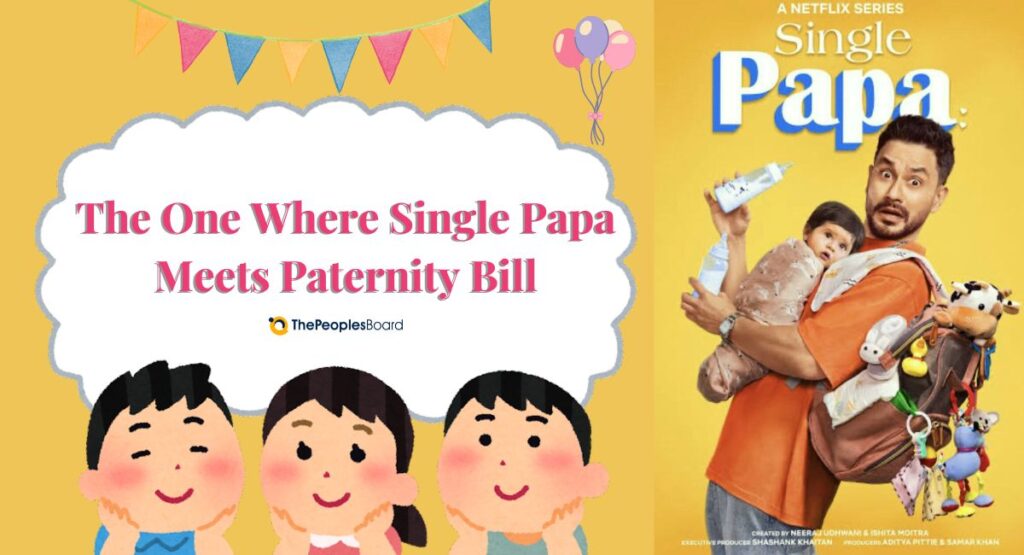


Amid the discussions over the paternity bill proposed by the MP Supriya Sule and workplace policies, Netflix drops an eye-opener. Single Papa, a Netflix series directed by Shashank Khaitan and Hitesh Kewalya, reflects the reaction and stereotypes of society towards men when it comes to childcare.
The show follows the journey of Gaurav Gehlot (played by Kunal Khemu), a divorced professional navigating the both regulatory and social complexities of child adoption. His struggle to balance caregiving and work mirrors a core concern, as noted by the proposed paternity bill.
“Childcare is a woman’s job” – what started as a feminist debate has sadly become a social norm. Why? Because for a long time in India, people have been conditioned to believe things like “men don’t cry”, which widely signifies that men aren’t supposed to be emotional beings, while childcare needs emotions. Though financial empowerment of women is a big deal in India, emotional empowerment of men is rarely discussed.
Unfortunately, a society which is considered highly patriarchal fails to understand the crises of men when it comes to childcare. And, as workplace policies are often influenced by social norms, such perspectives sometimes affect the Indian work culture too.
Current paternity mandates in India
The All India Services (Leave) Rules, 1955, lay down that the male employees of the central government, with less than two surviving children, may be granted paternity leave. Under this rule, the employee is entitled to leave for 15 days, during the confinement of his wife for childbirth, i.e. up to 15 days before, or up to six months from the date of delivery of the child.
A male member of the Service (including a probationer) with less than two surviving children, on valid adoption of a child below the age of one year, may be granted Paternity Leave by the competent authority for a period of 15 days, within a period of six months from the date of such adoption.
However, nothing mandates the private companies to offer these leaves, as is the case for maternity leave under the Maternity Benefit (Amendment) Act, 2017. Owing to this, about 14% of companies have no paternity leave policy, as found by JobsForHer in a study. The study further found that only 31% of SMEs/startups offered such leave, and 57% of large enterprises provided two weeks or more.
Emotional exhaustion
This uncertainty is where the emotional exhaustion begins. New fathers working for private firms are often compelled to balance personal responsibility with professional risk. Though companies, namely Deloitte, TCS, Zomato, Infosys, Wipro and more, have paternity leave policies in place, due to social stereotypes, employees often hesitate to ask for help.
In addition, the unspoken expectations of continued availability, late-night calls, urgent emails, or the subtle reminder that the “real work” must go on, accompanied by a judgmental gaze, is a constant pain for many fathers, especially the single ones.
For adoptive fathers, the strain is even sharper. While the central employment rule technically extends leave for adoption, the emotional needs of forming attachment, navigating social scrutiny, and building a new family unit are the real deal.
What is at stake?
Perhaps the most uncomfortable truth that Single Papa and the paternity leave debate uncover isn’t about India’s lack of policies, but about the lack of permission. Permission for men to care without explanation. Permission to be emotionally present without being professionally penalised and judged. Permission to redefine what responsibility looks like beyond paycheques. And the onus isn’t just on the workplaces but on society too.
When caregiving remains a negotiated privilege rather than a protected right, fathers learn to suppress their emotional vulnerability. The society questions them when they aren’t fully emotionally available for their families, and it also questions them when they want to offer their share of time and support to their families.
True progress will not come from extending leave days alone. It will come when society, as a whole, stops treating parents as genders and begins recognising them as a dimension of humanity.
In that sense, Single Papa is less a show about a single father and more a quiet reminder of what is at stake.