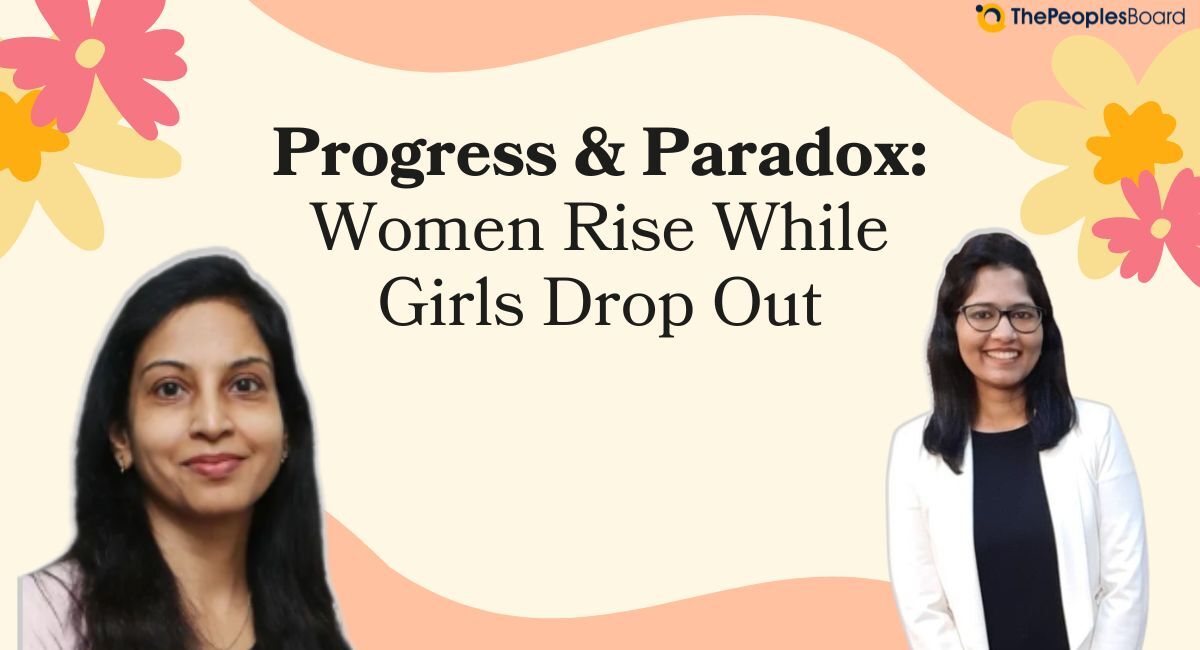

India’s momentum on women’s economic participation is no longer a whisper. It’s becoming measurable change at the grassroots. According to the latest Periodic Labour Force Survey, India’s female labour force participation rate (LFPR) rose sharply to 41.7% in 2023–24, up from about 23–24% in 2017–18.
This reflects a shift driven largely by greater engagement of rural women in work and livelihood activities. According to the survey, the LFPR of women has gone up to 47.6% in 2023-24 from 41.5% in 2022-23.
However, the survey further highlights two realities. First, much of the increase has been through informal and self-employment channels such as agriculture, casual work and small enterprises rather than stable salaried roles.
Second is the structural barrier. This covers persistent gender norms, limited childcare and safety concerns, and concentration in low-paid work. These continue to constrain women’s upward mobility and the quality of jobs they obtain.
Plus, data suggest that about 65.7 Lakh children dropped out of school in India, of whom nearly 29.8 Lakh were adolescent girls, underscoring persistent dropout challenges for girls across states. In the 2025–26 academic year alone, states like Gujarat identified 1.1 Lakh adolescent girls as out of school, while Assam and Uttar Pradesh reported 57,409 and 56,462 girls, respectively, among out-of-school children. This is a stark reminder that social and structural barriers still affect girls’ retention.
To address this growing concern, the Supreme Court recently identified menstrual hygiene as a key constraint. It said that it is a part of a child’s right to life under Article 21 of the Indian Constitution.
However, is just a court verdict enough?
On this, Alapinee Deshmukh, Director of Volunteers, Seva Sahayog Foundation, said, “While a judicial milestone is achieved, the gap lies in the transition from a legal right to a lived reality.”
She is of the view that the SC’s recognition of menstrual hygiene under the Right to Life is a monumental shift. It moves the needle from ‘charity’ to ‘entitlement.’ However, automatically, it doesn’t dissolve a centuries-old taboo. Legal backing is the skeleton; social empathy and infrastructure are the flesh and blood.
“We need more than just pads; we need a ‘Biological Citizenship’ where a girl doesn’t have to pay a ‘biological tax’ of dropping out of school just because she menstruates. We need systems which also allow for monitoring compliance periodically, ensuring the ruling isn’t just a one-time headline,” Alapinee added.
This reflects that the gap is in the roots of the development of a rural workforce, which could have also otherwise transformed into an urban workforce. The gap is in access to educational levels.
In other words, India is witnessing a paradox. Women’s economic participation is rising, especially in rural areas, but the educational foundation that could enable them to access better jobs and long-term career mobility remains fragile.
Closing this gap will require coordinated action, such as stronger school retention programmes, better sanitation infrastructure, community awareness, and livelihood pathways that encourage girls to continue education while preparing them for the future workforce.
With such access, it is highly possible to transform this youth power into the urban workforce. But how do big corporations and policy makers take the lead?
The CSR Structure
Under the Companies Act, 2013, large corporations in India are required to allocate 2% of their average net profits towards CSR activities, and education remains one of the most funded sectors under these initiatives, according to the Ministry of Corporate Affairs.
On this, Lulu Khandeshi, CHRO ManpowerGroup India, said, “The workforce of the future depends on the decisions we make today and on how intentionally we invest in pathways for girls and young women. CSR initiatives must evolve from symbolic commitments to structured, long-term interventions.”
She further added that, in addition to sponsorships, companies should also engage in the following activities:
- Mentorship and networking opportunities that connect young girls with working professionals who can guide and inspire them.
- Industry-aligned vocational training at the school level, giving girls early exposure to real-world skills and potential careers.
- Community programmes that address the root causes.
According to NITI Aayog’s India CSR Report, as carried out by Economic Times, corporate-led skill development initiatives have increasingly focused on rural youth and women to improve employability and income opportunities.
TPB’s analysis is that such interventions are crucial in ensuring that girls who stay in school are also able to transition into meaningful employment later. By connecting education with practical skills and local job opportunities, CSR programmes can help transform school retention into long-term workforce participation.
Transitioning To Workforce
However, retaining girls in school and CSR are only baby steps. The larger challenge is helping them transition from education into meaningful employment. This requires stronger links between schooling, skills training and job opportunities.
On this, Lulu Khandeshi said, “Secondary education is the foundation of workforce readiness. When girls drop out at this stage, we lose future professionals, technicians, entrepreneurs, and leaders before they even enter the pipeline. I sense that the numbers would not be any different for boys either, and the broader issues around supporting children’s education needs to be addressed.”
Interestingly, the National Education Policy (NEP) 2020, released by the Ministry of Education, calls for the integration of vocational education and skill development from the school level so that students can gain practical skills alongside academic learning.
The policy aims to expose at least 50% of learners to vocational education by 2025, helping young people prepare for real-world work opportunities. Such initiatives are particularly important for girls in rural areas, where early exposure to skills, entrepreneurship and digital literacy can help them remain engaged in education while also building pathways into the workforce.
In addition, the Ministry of Women and Child Development stated that the Beti Bachao Beti Padhao initiative has helped increase awareness about girls’ education and encouraged communities to prioritise keeping girls in school.
Such interventions are crucial because education does not just benefit individual girls; it strengthens the long-term workforce pipeline by ensuring that more women enter the economy with better skills, confidence and career opportunities.
Going Forward
These efforts highlight a broader shift in how education and employment are being viewed in India. It is no longer enough to simply enrol girls in school. The focus is gradually moving towards ensuring that education leads to real opportunities in the labour market.
On the future of education of girls in rural India, Alapinee Deshmukh said, “Whether it is a CSR member designing a menstrual-friendly workplace or an ASHA worker debunking myths in a remote hamlet, every action contributes to a more equitable India. We are moving past the era of ‘awareness’ and entering the era of ‘accountability.’ As we’ve discussed today, providing a pad is a start, but providing a path to education, to health, and to career longevity, is the ultimate goal. The right to life is, after all, the right to live with dignity, every single day of the month.”
When girls remain in school longer and gain exposure to practical skills, they are better prepared to enter the workforce with confidence. However, if structural barriers such as dropout rates, limited infrastructure and social norms continue to persist, the progress seen in women’s grassroots participation may remain uneven.
Bridging this gap between classrooms and careers will therefore be critical to sustaining India’s growing momentum in women’s economic participation.