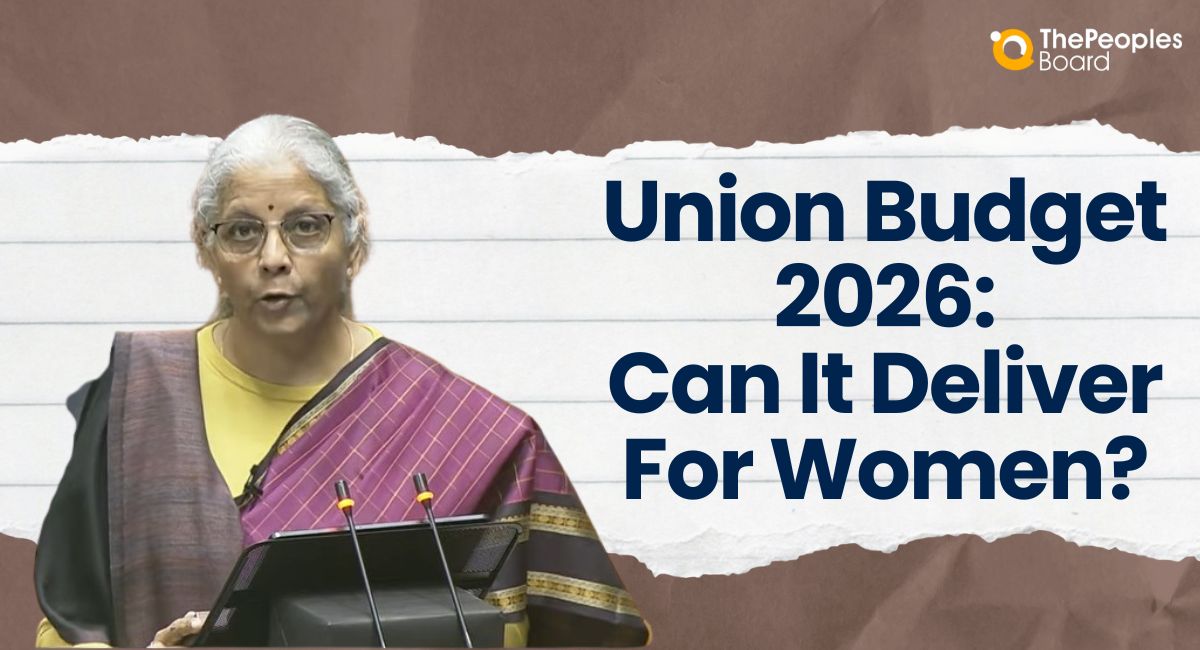

Despite progress, women’s economic participation in India remains significantly lower than that of men, which is a foundational challenge for inclusive and sustainable growth. According to recent Periodic Labour Force Survey (PLFS) data, the labour force participation rate (LFPR) for women aged 15 and above is around 41.7% in 2023-24, up sharply from the low 20s just half a decade ago, yet still below global averages and far below male participation.
This rise reflects aspiration, intent, and economic necessity. But it also exposes persistent structural gaps around access, safety, skilling, care responsibilities, and market integration that continue to shape women’s economic journeys when compared to those of men.
It is this tension and the structural barriers that set the context for the Union Budget 2026. Rather than treating women’s inclusion as a standalone social concern, the Budget appears to recognise it as a systemic economic issue that requires intervention across education, employment, and enterprise.
Central Budget 2026: Acknowledging the Gaps
The Union Budget 2026 counters such statistics. The rise in female labour force participation over the past few years signals aspiration, intent, and necessity. Still, it also exposes structural gaps around access, safety, skilling, care responsibilities, and market integration.
From Beti Bachao Beti Padhao to the changes brought about in the labour laws recently, upliftment of women at the ground level has been discussed by the current BJP-led government multiple times.
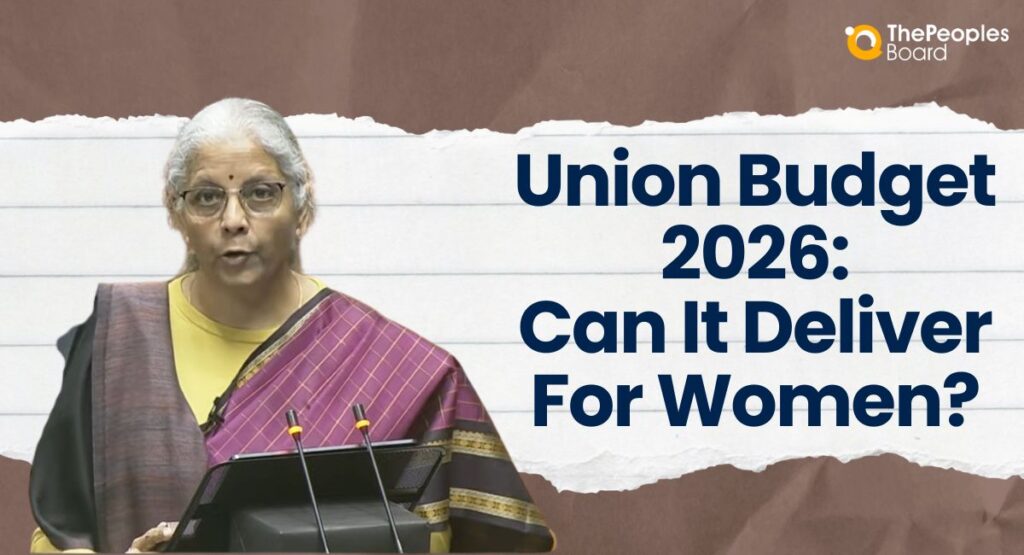
The same was again highlighted during the presentation of the recent Budget. For the financial year 2026-27, Finance Minister Nirmala Sitharaman proposed some initiatives targeted at boosting the inclusion of women in education as well as work, especially at the ground level.
During the speech, she said, “Our aim is to transform aspiration into achievement and potential into performance, as we ensure that the dividends of growth reach every farmer, the scheduled caste, the scheduled tribes, the nomads, the youth, the poor and the women.”
The proposals by the FM for women span multiple touchpoints of the economic lifecycle such as learning, earning, caregiving, and entrepreneurship. Here’s what she listed for the women in the Budget this year:
- The government will undertake initiatives for the integrated development of 500 reservoirs and Amrit Sarovars to strengthen the fisheries value chain in coastal areas and enable market linkages involving start-ups and women-led groups, together with Fish Farmers Producer Organisations.
- Building on the success of the Lakhpati Didi Programme, FM proposed helping credit-led women’s livelihoods take root as the next owners of enterprises. Self-Help Entrepreneur (SHE) Marts will be set up as community-owned retail outlets within the cluster-level federations through enhanced and innovative financing instruments.
- In Higher Education STEM institutions, prolonged hours of study and laboratory work pose some challenges for female students. Through VGF/capital support, 1 girls’ hostel will be established in every district.
Further, the initiative around a Care Ecosystem, covering geriatric and allied care services backed by NSQF-aligned programmes to train multiskilled caregivers, is also expected to benefit women in the coming financial year.
Also, given that the FM recognised it as the “Yuva Shakti-driven Budget”, the idea to enhance the capacity of all youth, including women, through initiatives like the AVGC (Animation, Visual Effects, Gaming, and Comics) Content Creator Labs in 15,000 secondary schools and 500 colleges, are also expected to include girls.
From Policy to Employability: What Industry Sees
Though the success of the policies proposed in the Budget remains to be seen, industry leaders see them as promising measures to boost women’s participation in the labour force and in education.
Commenting on the Lakhpati Didi programme, Anjan Pathak, CTO and Co-founder of Vantage Circle, said, “At Vantage Circle, we strongly believe that empowering women is crucial for building inclusive, diverse, and innovative workplaces. The ‘Lakhpati Didi 2.0’ initiative, with its focus on advanced technical training and digital financial literacy, is a game-changer that will enable women to transition into business owners and leaders in their own right.”
Further, Viswanath PS, MD & CEO, Randstad India, said, “Equally vital is the Budget’s sharp
focus on bridging the gap between education and employability. Initiatives like the Education-to-Employment Standing Committee, the expansion of women in STEM through district-level hostels, and the SAMARTH 2.0 framework for the textile sector reflect a clear commitment to building a future-ready workforce. These measures directly address the industry’s need for skill-aligned, productivity-led hiring.”
This comes at a very crucial time. During the winter session of the Parliament, Shobha Karandlaje, Minister of State for the Ministry of Micro, Small and Medium Enterprises, revealed that about 26,000 MSMEs have closed 1,61,580 jobs across the country. According to the report, these included many which were led by women across states, namely Maharashtra, West Bengal, Tamil Nadu, Karnataka, and Andhra Pradesh.
At such a time, the initiative for a boost is expected to bring relief at the ground level. But what is the current status of women’s employment in the country? What serves as the foundation for this Budget?
According to a blog by Drishti IAS, this is what the current status of female labour force participation looks like:
Female labour force participation rate has shown encouraging growth, reaching 41.7% in 2023-24, up from under 30% a decade ago.
- Women’s participation is increasing, particularly in the formal sectors, the gig economy, and skilled jobs such as IT and healthcare.
- Self-employment among women rose from 51.9% in 2017 to 67.4% in 2024, indicating growing economic independence and entrepreneurship opportunities.
These trends suggest momentum but also raise a critical question. Are current policy interventions strong enough to convert participation gains into long-term economic security and leadership for women? Let’s take a look at history to analyse it.
A key initiative aimed at improving the lives of women and children at the ground level was the concept of Anganwadis. Launched in 1975, as part of the Integrated Child Development Services (ICDS), these centres served as the crucial, rural-focused hubs targeting child malnutrition, health, and education. This was also known to serve as a key employment generation process for women in the rural areas of India. About 1.4 million women as grassroots workers (AWWs) and helpers (AWHs) are employed at these centres.
However, according to a Factly report, there has been a steep fall in the number of Anganwadis between 2016 and 2020; the number of beneficiaries fell by more than 14%. In Bihar alone, the beneficiary count dropped from 1.15 crore in 2017 to approximately 73 lakh by 2019. Referring to cases like these, it is crucial to critically assess the potential of the current women-centric policies proposed by the government.
What needs to be done for long-term success?
For these initiatives to translate into long-term, structural change, the focus must now shift from rollout to retention. History shows that women’s participation in India rises during periods of economic or policy push, but often drops once support systems weaken or life-stage pressures intervene.
According to ThePeoplesBoard’s analysis of the matter, equally critical is the expansion of care infrastructure, mobility, and safety frameworks, without which women’s economic journeys remain fragile and reversible.
Unless women are enabled to stay in education, remain in the workforce, and scale their enterprises across years—not just enter them—these initiatives risk becoming short-term accelerators rather than long-term enablers of economic agency.
Data suggests that about 65.7 Lakh children dropped out of school in India, of whom nearly 29.8 Lakh were adolescent girls, underscoring persistent dropout challenges for girls across states. In the 2025–26 academic year alone, states like Gujarat identified 1.1 Lakh adolescent girls as out of school, while Assam and Uttar Pradesh reported 57,409 and 56,462 girls, respectively, among out-of-school children. This is a stark reminder that social and structural barriers still affect girls’ retention.
Recently, the Supreme Court passed a landmark judgement about the right to menstrual hygiene of girls in schools. A Bench of Justices J.B. Pardiwala and R. Mahadevan said that basic menstrual hygiene is a part of a child’s right to life under Article 21 of the Indian Constitution. On these grounds, it issued a set of mandatory directions to all states and UTs (union territories) to ensure free sanitary napkins, functional gender-segregated toilets, and menstrual health awareness in every school across the country.
What should have been done earlier with the intervention of the government had to be taken up by the apex court in 2026. Analytically, TPB is of the view that more such measures are required for not just the success of women-centric policies but also for the true success of the ideas of Viksit Bharat by 2047.
Designing Continuity for the Future
By addressing education access, enterprise ownership, skilling, and care infrastructure together, the Central Budget acknowledges that women’s participation is shaped by an ecosystem, not isolated schemes. Yet its long-term success will depend on whether these initiatives help women stay the course through education, employment, and entrepreneurship, rather than merely enter them.
Participation rises, enrolments improve, enterprises are seeded, but continuity remains fragile. What women in India need is not another cycle of entry-level interventions, but policy endurance that travels with them across education, work, caregiving, and entrepreneurship.
At a time when lakhs of girls still exit the education system and women-led enterprises remain vulnerable to economic shocks, Budget 2026 has laid down intent with clarity. The real test now lies in execution, continuity, and accountability. The real measure of success will be determined by the retention of women in the labourforce and education.
As mentioned above, until care infrastructure, safety, mobility, and market access are treated as economic enablers rather than social add-ons, women’s progress will remain reversible. Without continuity, even well-designed policies risk becoming temporary boosts rather than lasting reforms.