


The best person for your open role probably isn’t reading your job post. They are employed, reasonably content, and not checking Naukri on their lunch break. They are a passive candidate, and in most Indian talent pools, they outnumber active applicants by a wide margin. Recruiters who only fish where the active seekers swim are competing for a fraction of the market while ignoring the rest.
Passive talent acquisition is the discipline of finding, engaging, and converting people who aren’t actively job-hunting but would move for the right opportunity. It matters more now because hiring in India has become genuinely hard.
About 80% of Indian employers said they struggled to find the skilled talent they needed in 2025, according to the ManpowerGroup Talent Shortage Survey of over 3,000 employers in India, a figure that has sat stubbornly high since 2022 and runs above the global average of 74%.
So, the pool of people openly looking is smaller and less qualified than most hiring plans assume.
What Counts as a Passive Candidate
A passive candidate is a currently employed professional who is not actively searching for a new job but is open to hearing about the right one. They sit somewhere between the fully committed “won’t move for anything” employee and the active seeker refreshing job boards daily.
The split is lopsided. LinkedIn Talent Solutions research, drawn from a survey of 18,000 professionals across 26 countries, has long put roughly 70% of the global workforce in the passive category, meaning only about 30% are actively applying at any given time. Those aren’t fringe candidates. They’re the employed majority your job posts never reach.
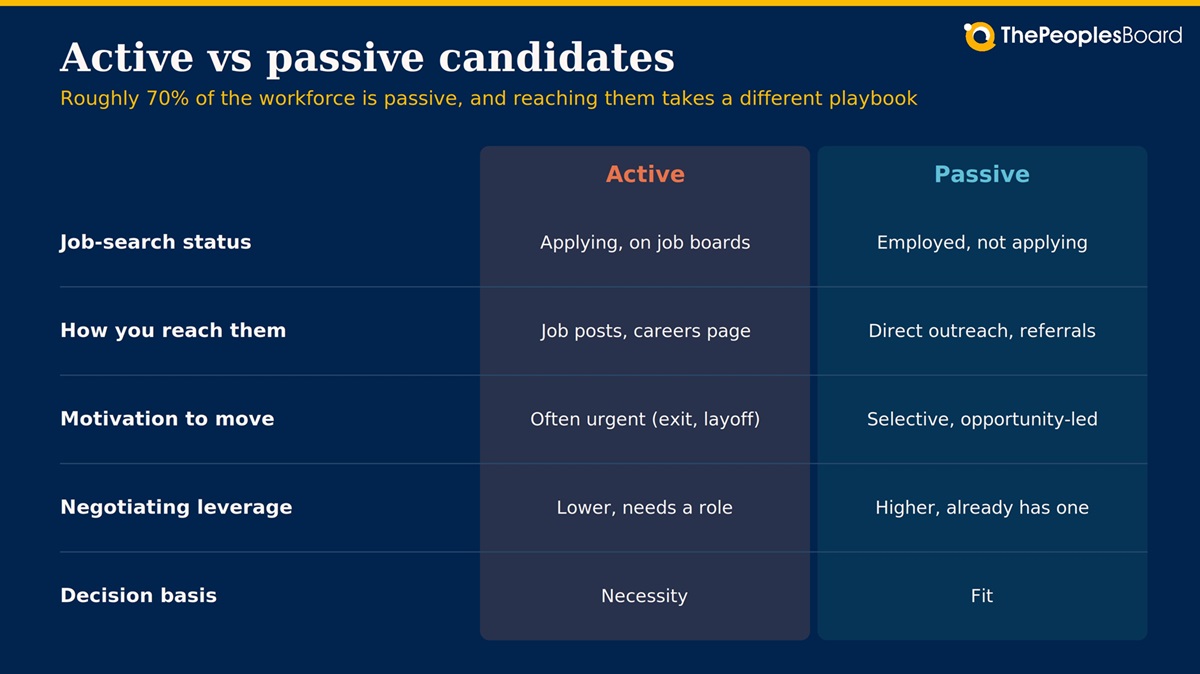
The reason passive candidates are worth the extra effort isn’t snobbery about active seekers. It’s selectivity. Because a passive candidate already has a job, they evaluate an offer on fit rather than necessity, which tends to produce a more considered decision on both sides.
Why Passive Hiring Is Now a Core Strategy in India
Attrition has cooled. Aon’s Annual Salary Increase and Turnover Survey 2025-26, which analysed data from more than 1,400 organisations across 45 industries, found overall attrition declined to 16.2% in 2025, down from 17.7% in 2024 and 18.7% in 2023, returning close to pre-COVID levels.
Lower churn is good for stability, but it has a side effect for recruiters: fewer good people are voluntarily entering the active market. When your competitors’ best employees stop quitting, the only way to reach them is to go to them.
Mercer | Mettl’s India’s Graduate Skill Index 2025, which assessed over a million students across 2,700-plus campuses, found only 42.6% of Indian graduates employable, down from 44.3% a year earlier. High applicant volume doesn’t mean high qualified-applicant volume, which is exactly why active-only sourcing disappoints.
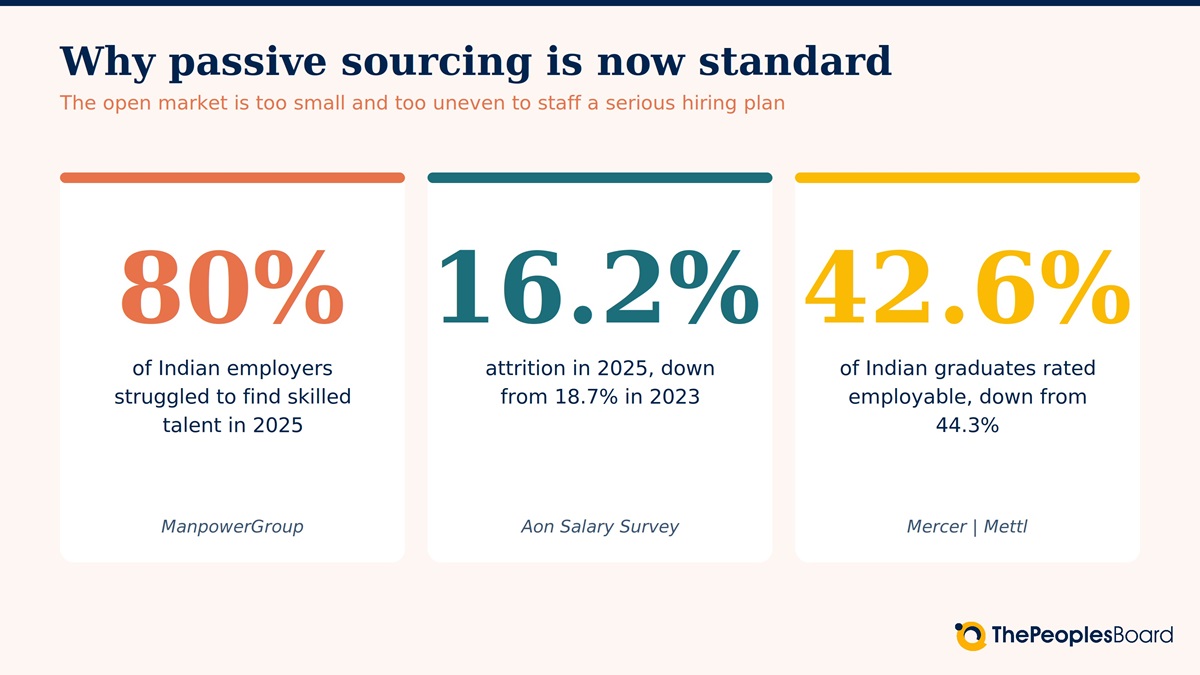
A few forces are pushing passive sourcing from “nice to have” to standard practice:
- A persistent skills gap: When 4 in 5 employers can’t fill roles from the open market, the passive pool becomes the backup source, not the bonus.
- Falling attrition: With churn down to 16.2%, stable workforces mean the strongest candidates rarely surface as active applicants.
- Specialised roles: For AI, data, cybersecurity, and semiconductor talent, the qualified population is small and almost entirely employed. India is staring at a projected semiconductor talent gap running into the lakhs by 2030.
- Employer brand pressure: Passive candidates research a company before replying, so reputation now does the first round of screening for you. Our coverage of why employer branding has become a survival strategy unpacks how much this now weighs on outreach response rates.
How to Attract and Engage Passive Talent
Passive candidates don’t respond to the same playbook as active ones. A job post won’t reach them. A generic InMail won’t move them. What works is a slower, more deliberate approach built on relevance and reputation.
Build a Sourcing Engine, Not a Job Post
You have to go find these people, because they won’t come to you. That means proactive sourcing through professional networks, Boolean searches, industry communities, and events.
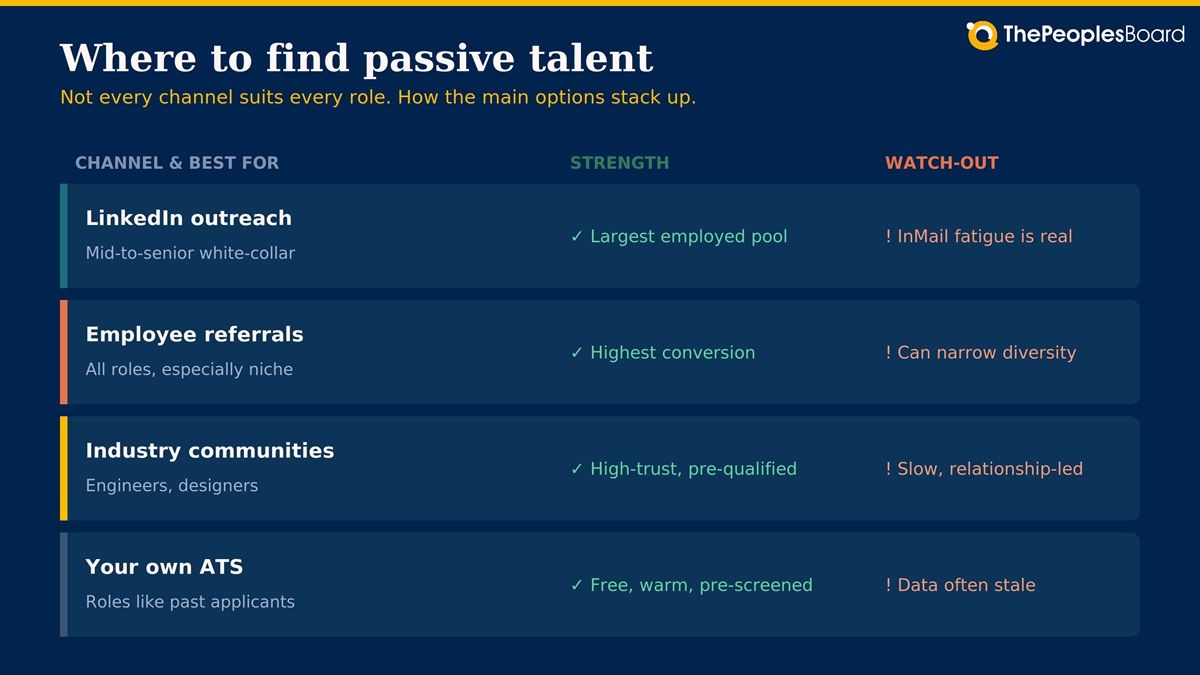
LinkedIn remains the primary channel. Recruiters overwhelmingly use it as their first sourcing tool, and it’s where the concentration of employed mid-to-senior professionals is highest. India is LinkedIn’s second-largest market after the United States, with over 135 million users, which makes it a realistic sourcing ground for most white-collar roles.
Complement it with GitHub for engineers, Behance for designers, and sector-specific WhatsApp and Slack groups where practitioners actually gather.
Lean Hard on Employee Referrals
Referrals are the single most efficient route to passive talent, and the data is not subtle about it. Referral programs are roughly 10 times more effective at hiring passive candidates than job boards, and referred candidates are about 17% less likely to drop out of the recruitment funnel than those sourced through job ads.
There’s a reason Indian IT majors pour money into this. TCS has run referral bonus schemes of up to ₹40,000 to speed up hiring, and Infosys has paid employees for helping with recruitment. Your own employees know qualified people who aren’t looking, and a warm introduction from a trusted colleague clears the trust barrier that cold outreach spends weeks trying to climb.
Write Outreach a Human Would Actually Answer
Cold outreach to passive candidates fails when it reads like a mass mail. It works when it’s specific.
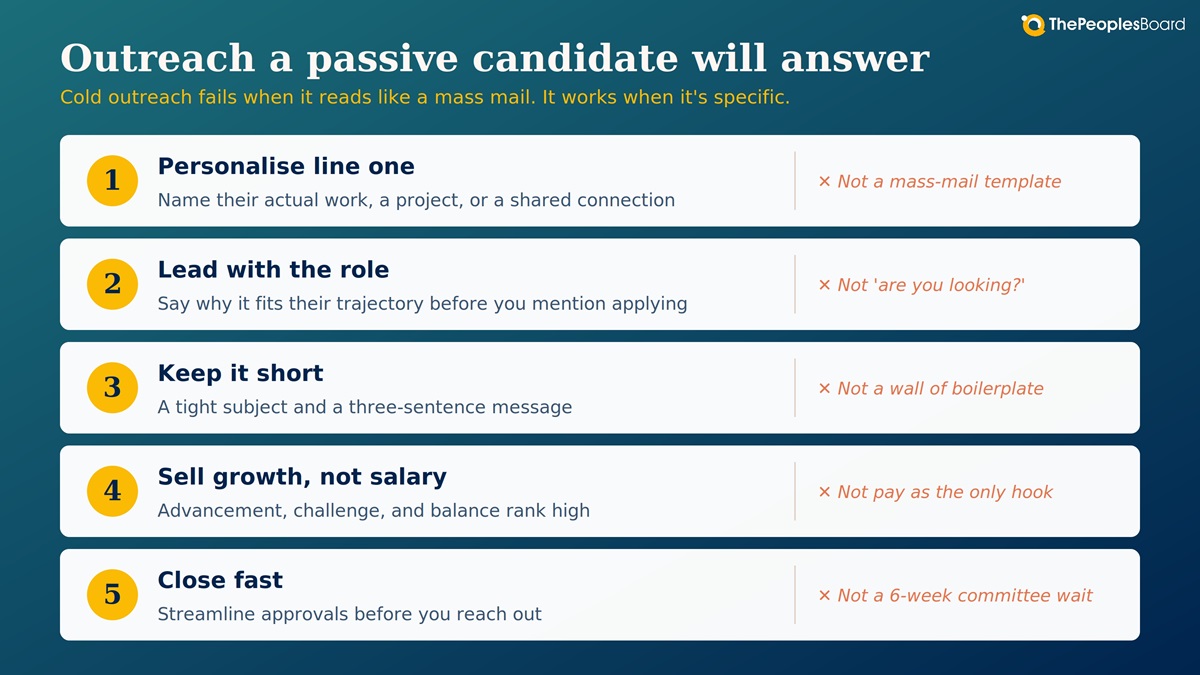
- Personalise the first line: Reference their actual work, a shared connection, or a specific project. Candidates respond far more to messages that name a mutual contact than to generic pitches.
- Lead with the role, not the ask: Explain why this opportunity fits their trajectory before you mention applying.
- Keep it short: A tight, specific subject line and a three-sentence message beat a paragraph of boilerplate.
- Sell growth, not just salary: Compensation matters, but advancement, challenge, and better work-life balance rank consistently high among reasons passive candidates say they would move.
Fix the Speed Problem
Passive candidates lose interest when hiring drags. This is an India-specific weak spot: approval bottlenecks routinely stretch hiring cycles, with some processes taking 35 to 45 days just to clear internal sign-offs. A passive candidate you courted for a month will not wait another six weeks for a committee. Streamline approvals before you start the outreach, not after.
Passive Sourcing Channels Compared
Not every channel suits every role. Here’s how the main options stack up for the Indian market.
One channel most companies underuse is their own database. Every strong candidate who once reached the final round and didn’t get the offer is a warm passive lead sitting in your applicant tracking system. So is the ex-employee who left on good terms. TPB’s look at how boomerang hires can solve onboarding drag makes the case for treating alumni as a live talent pool rather than a closed chapter.
The Retention Side of the Equation
Here’s the uncomfortable truth about passive hiring: your best employees are somebody else’s passive candidates. The same tactics you use to poach are being aimed at your people right now.
That’s why passive talent strategy can’t be separated from retention strategies. Every regretted exit is a role you now have to fill from a shrinking pool, at a mid-senior replacement cost that runs several lakhs per hire before you count the months of lost productivity.
Stay interviews, clear growth paths, and manager quality do double duty here. They keep your own passive-target employees in place while making your company the kind of employer other passive candidates want to hear from. The debate over where to invest, retention or recruitment, is worth reading before you tilt your budget too far in either direction.
In the End…
Attracting passive talent isn’t a clever recruiting hack. It’s a response to a market where the open pool is too small and too uneven to staff a serious hiring plan. With 80% of Indian employers struggling to fill roles and attrition down to 16.2%, the people you actually want are employed, quiet, and getting messaged by your competitors.
Reaching them takes patience and specificity, not volume. Build a real sourcing engine, make referrals the backbone, write outreach that respects the reader, and close fast enough that a courted candidate doesn’t cool off in an approval queue.
Keep one eye on your own bench, because the strongest passive-hiring strategy in the world won’t help if it’s busy backfilling talent you could have kept. Start by auditing your ATS for warm past applicants this week. The best candidate you need may already be one conversation away.
FAQs
What is a passive candidate?
A passive candidate is a currently employed professional who is not actively searching for a new job but is open to hearing about the right opportunity. They sit between the fully committed employee who won’t move for anything and the active seeker refreshing job boards daily. Roughly 70% of the global workforce falls into the passive category.
Why is passive hiring important in India right now?
About 80% of Indian employers struggled to find skilled talent in 2025, while attrition fell to 16.2%, meaning fewer strong people voluntarily enter the active market. Only 42.6% of Indian graduates are considered employable. With a persistent skills gap and specialised roles in AI, data, and semiconductors almost entirely filled by employed professionals, the passive pool becomes a core source rather than a bonus.
How is a passive candidate different from an active candidate?
An active candidate is applying, interviewing, and visible on job boards, often moving out of urgency like an exit or layoff. A passive candidate is employed, not applying, and reached through direct outreach or referrals. Because a passive candidate already has a job, they evaluate an offer on fit rather than necessity, which tends to produce a more considered decision on both sides.
How do you attract and engage passive candidates?
Build a proactive sourcing engine through professional networks, Boolean searches, and industry communities rather than relying on job posts. Lean on employee referrals, which are roughly 10 times more effective at hiring passive candidates than job boards. Write short, personalised outreach that leads with the role, sells growth over salary, and closes fast before the candidate cools off.
What is the best channel for sourcing passive talent in India?
LinkedIn is the primary channel for mid-to-senior white-collar roles, with India its second-largest market at over 135 million users. Employee referrals deliver the highest conversion and lowest drop-off across all roles. Industry communities suit engineers and designers, and your own ATS holds warm past applicants and boomerang candidates who are already screened.
How does retention connect to passive hiring?
Your best employees are somebody else’s passive candidates, targeted by the same tactics you use to poach. Passive talent strategy cannot be separated from retention, because every regretted exit is a role you must refill from a shrinking pool at a mid-senior replacement cost of several lakhs per hire. Stay interviews, clear growth paths, and manager quality keep your people in place while strengthening your employer brand.