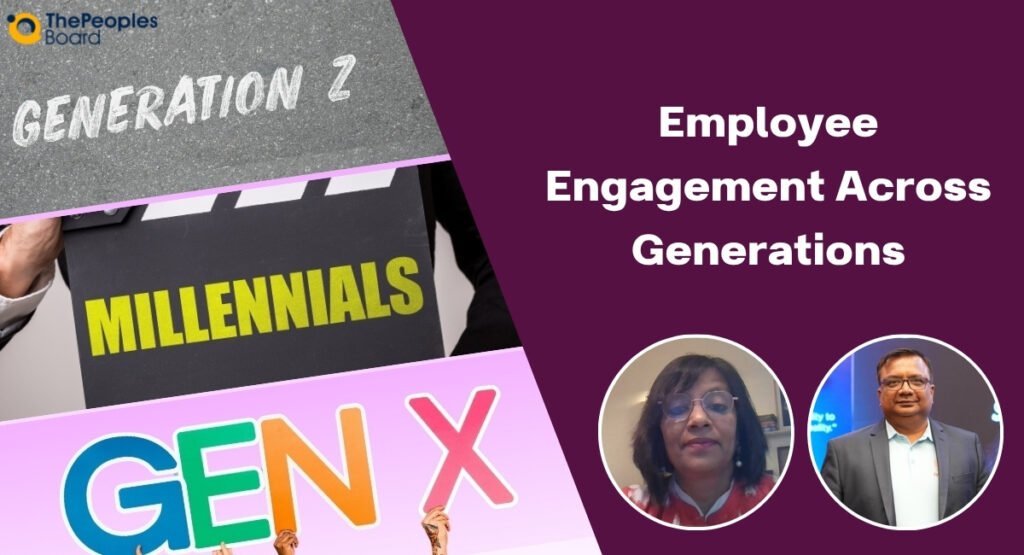

Three generations now share the average Indian office floor, and they do not experience work the same way. A Gen X team lead who measures loyalty in years sits two desks from a Gen Z analyst who measures it in months. Between them sits a millennial manager trying to translate one to the other.
The engagement data confirms what that seating chart already suggests: the emotional contract between employee and employer looks different for each cohort, and the model most Indian HR teams still run was built for only one of them.
Employee engagement measures emotional commitment to an organisation and its goals, not surface-level job satisfaction. It shows up in discretionary effort, the extra initiative an employee brings when no policy requires it. That distinction matters more in 2026 because the gap between generations is now wide enough to affect attrition, productivity, and cost.
Why Generational Engagement Data Matters Now
India’s workforce is younger and more generationally mixed than almost any major economy. Gen Z now makes up close to 27% of the country’s workforce, and inside India’s global capability centres, Gen Z and millennials together account for 93% of headcount. Gen X, though a smaller share, still holds a disproportionate number of managerial and senior roles, which means they shape how engagement policy actually reaches the floor.
“Whenever we meet, HR leaders and CHROs across organisations, I think one of the things that keeps us awake at night is innovating to adapt our practices to a multi-generational workforce,” said Susmita Malik, VP of HR for India at [24]7.ai, in her conversation with TPB.
“So, if I look at our organisation itself, we have four generations as of today working in the same place. We have a few baby boomers who are part of senior management. And then, of course, we have the Gen X, we have the millennials, and then we have the Gen Zs.”
The stakes are financial, not just cultural. India’s overall attrition eased to 16.2% in 2025, close to pre-pandemic levels, according to Aon’s Annual Salary Increase and Turnover Survey 2025-26. But a moderating headline number hides who is actually leaving. The strain concentrates among the youngest workers.
In India, 54% of Gen Z have delayed major life decisions because of financial constraints, per Deloitte’s 2026 Gen Z and Millennial Survey, a pressure that feeds directly into how long they stay. The engagement gap and the attrition gap are the same problem seen from two angles, and both point most sharply at the newest entrants to the workforce.
Gen Z: High Expectations, Low Tenure
Gen Z entered the workforce during a pandemic, a hiring freeze, and an AI transition, and their engagement reflects that turbulence. In India, they are leaving fast enough to distort hiring plans.
Often in the headlines for professional, political, or light-hearted reasons, Gen Z has broken many moulds in recent years. Though still in the learning phase, this young generation is also teaching others, according to prominent leaders.
“I’m a big fan of Gen Z because this is where I understand that I am learning. It’s reverse learning and reverse engineering which is happening,” Sudhir Mateti, CHRO at Syntel by Arvind, explained in his conversation with TPB.
“I learn a lot from these Gen Z. There is a long way for me to go to learn from these Gen Z. They are quite gadget-oriented. They are quite quick on their toes. They decide very fast. They are more rational than our traditional people, you know.”
Nearly 40% of hiring at India’s global capability centres is now driven by backfilling vacated roles rather than net new growth, according to a Quess Corp report covered by Business Today, which flags shorter Gen Z tenures as a key factor complicating workforce planning.
What drives their engagement is well documented and specific:
- Recognition cadence over ceremony. Gen Z respond to frequent, timely feedback rather than annual reviews. They treat recognition as reassurance that their effort registers, not as a year-end formality.
- Financial security as a precondition. Deloitte’s data shows financial strain is more acute for Gen Z than for older cohorts, and without that stability, they are less likely to find their work meaningful or worth staying for.
- Growth and skills. They want visible progression and AI-era skills, and they disengage quickly when a role stalls.
- Workplace relationships. Around 79% to 80% of Indian Gen Z and millennials count colleagues as friends, per Deloitte’s 2026 Gen Z and Millennial Survey, and those with work friendships are markedly more likely to stay.
Gen Z is not rejecting work. They are rejecting an engagement model built around annual surveys, generic perks, and hierarchy-first feedback loops. TPB’s breakdown of what HR teams get wrong about Gen Z engagement argues the problem is one of design, not motivation.
Millennials: The Squeezed Middle
Millennials, now largely in their thirties and early forties, carry a different weight. Many are in first-time or mid-level management, which places them at the exact pressure point Gallup identifies as the epicentre of the engagement decline. Manager engagement globally fell from 27% in 2024 to 22% in 2025, and South Asia, primarily India, recorded an eight-point drop in manager engagement, the steepest of any region.
Their priorities overlap with Gen Z but tilt toward stability. In India, 44% of millennials have delayed major life decisions due to financial constraints, slightly below Gen Z but still substantial. They seek what Deloitte calls a trifecta of money, meaning, and well-being, and they are more likely than Gen X to leave when one of the three is missing.
The millennial engagement challenge is structural. They are asked to deliver on business targets while absorbing shrinking budgets, higher Gen Z turnover, and rising expectations from the teams below them, often without adequate management training. Where organisations invest in manager capability, that investment tends to lift engagement across every cohort those managers touch.
Gen X: The Stabilising Anchor
Gen X, born roughly between the mid-1960s and early 1980s, is the smallest of the three cohorts but often the most engaged and the most loyal. Global retention research consistently shows older cohorts anchoring in their current roles, though recent US data from Eagle Hill Consulting shows a divergence, with older employees trending lower on culture and organisational confidence even as they stay put.
Direct India-specific engagement data on Gen X is thinner than for the younger cohorts, and that gap is itself worth naming. Much of the survey infrastructure, from Deloitte’s flagship study to most vendor recognition research, is built around Gen Z and millennials. Gen X is frequently the reference point against which younger behaviour is measured rather than a subject of dedicated study.
What the available evidence does suggest is a distinct engagement profile:
| Engagement Driver | Gen X Tendency |
| Recognition style | Values substantive, less frequent recognition tied to outcomes |
| Autonomy | High; prefers being trusted over being monitored |
| Loyalty horizon | Longest of the three; measures commitment in years |
| Feedback preference | Direct and periodic rather than continuous |
| Primary risk | Quiet disengagement while remaining in role |
The risk with Gen X is not visible exit. It is the “great detachment,” staying in a role without the emotional investment that once came with loyalty. Because they rarely resign loudly, disengaged Gen X employees can go unmeasured by systems tuned to catch flight risk in younger cohorts.
How the Three Generations Compare
“Whether it is the way we have crafted the organisation’s vision, our communication strategies, our leadership styles, our modes of engagement with different generations who have different expectations, our models of performance management, our learning methodologies, or career progression plans, we have had to do this balancing act with agility, with flexibility and adaptability to accommodate the needs of each generation,” shared Susmita.
“And we’ve also had to create new platforms through which each of these generations can seamlessly blend with each other and bring out the best of each generation without losing their unique identity.”
The differences are easier to act on when placed side by side. The table below draws on Gallup, Deloitte India, and Aon data, with Gen X drawn partly from global research given the India data gap.
| Dimension | Gen Z | Millennials | Gen X |
| Approx. share of India workforce | ~27% and rising | Largest current bloc | Smaller, senior-heavy |
| Recognition preference | Frequent, real-time | Regular, growth-linked | Periodic, outcome-linked |
| Loyalty horizon | Months to ~1 year | A few years | Many years |
| Top engagement lever | Recognition and growth | Money, meaning, well-being | Autonomy and trust |
| Primary attrition risk | Fast, visible exit | Burnout-driven exit | Quiet disengagement |
| Financial-strain signal (India) | 54% delayed life decisions | 44% delayed life decisions | Comparatively lower |
A pattern runs through the table. The younger the cohort, the shorter the feedback cycle they expect and the faster their engagement erodes when that cycle is missing. The older the cohort, the more engagement hinges on autonomy and the harder disengagement is to detect.
What This Means for Indian HR Teams
The instinct to build a separate playbook per generation is the wrong lesson. Running three parallel engagement programmes is unaffordable and, more importantly, misreads the data. The common thread across all three cohorts is that engagement responds to manager quality and feedback cadence, not to generational stereotypes.
A few practical shifts follow from the evidence:
- Fix the measurement layer first. Generic annual surveys return a score without telling HR what to fix. Diagnostic, higher-frequency listening catches Gen Z flight risk and Gen X detachment before either shows up in attrition numbers.
- Invest in managers over perks. Since manager engagement is collapsing fastest in India and managers drive most of the variance in team engagement, capability-building here lifts every cohort at once.
- Match recognition to cadence, not to age. The mechanism, timely and specific recognition, is the same across generations. Only the frequency changes.
- Segment the risk, not the humanity. Use generational data to know where to look, then treat the individual. Intergenerational tools such as reverse mentoring, covered in TPB’s piece on bridging the generational divide, work precisely because they connect cohorts rather than separating them.
In the End…
The generational engagement gap in India is real, but it is often misdiagnosed. The numbers do not show three groups who want fundamentally different things. They show three groups who need the same things: recognition, growth, autonomy, and good managers, delivered at different speeds and detected through different signals. Gen Z disengages loudly and quickly. Gen X disengages quietly and slowly. Millennials, caught in the managerial middle, absorb the pressure from both directions.
For HR teams still running a 2015-era engagement model on a 2026 workforce, the fix is not a new programme per generation. It is a better measurement system, stronger managers, and the discipline to read each cohort’s signals for what they are. The organisations narrowing the gap are not spending more. They are measuring differently and treating feedback as a habit rather than an annual event.
FAQs
How does employee engagement differ across Gen Z, millennials and Gen X?
The three generations need the same things, recognition, growth, autonomy and good managers, but at different speeds. Gen Z expects frequent, real-time recognition and disengages fast. Millennials prioritise money, meaning and well-being and are prone to burnout-driven exit. Gen X values autonomy and outcome-linked recognition, and tends to disengage quietly while staying in role.
What share of India’s workforce is Gen Z?
Gen Z makes up close to 27% of India’s workforce and is rising. Inside India’s global capability centres, Gen Z and millennials together account for 93% of headcount, while Gen X holds a smaller but senior-heavy share concentrated in managerial and leadership roles.
Why is Gen Z attrition higher in India?
Financial strain and a mismatch with legacy engagement models drive Gen Z attrition. In India, 54% of Gen Z have delayed major life decisions due to financial constraints per Deloitte’s 2026 survey. Nearly 40% of hiring at India’s GCCs is now backfilling vacated roles rather than net new growth, with shorter Gen Z tenures cited as a key factor.
What is the biggest engagement risk with Gen X employees?
The main risk with Gen X is quiet disengagement, or the great detachment, where employees stay in a role without the emotional investment loyalty once carried. Because they rarely resign loudly, disengaged Gen X employees often go undetected by systems tuned to catch flight risk in younger cohorts.
How should Indian HR teams engage a multi-generational workforce?
Running three separate engagement programmes is unaffordable and misreads the data. Instead, fix the measurement layer with higher-frequency listening, invest in manager capability since manager engagement is falling fastest in India, and match recognition cadence rather than building age-based playbooks. Segment the risk, then treat the individual.