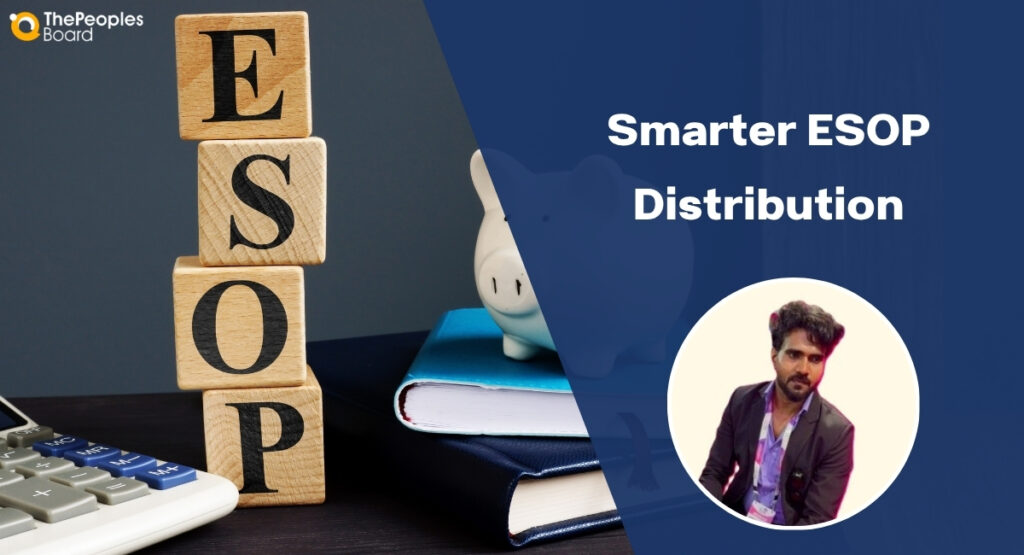

Grant Thornton Bharat’s 2024 survey of long-term incentive plans found that 75% of Indian companies now offer ESOPs, RSUs, or SARs, up from 63% in 2020. Startups aren’t just granting more equity either. In 2024 alone, 23 Indian startups ran ESOP buyback programmes that put more than ₹1,448 crore into the pockets of over 3,000 employees.
That’s a lot of equity moving through HR and finance teams that, in many companies, are still running the entire process on spreadsheets.
The gap between how fast ESOPs are scaling and how most companies actually administer them is where things start to break. Grant tracking gets messy. Vesting dates get missed. Employees email HR asking what their options are actually worth, and nobody has a fast answer. None of this is a talent problem. It’s an infrastructure problem, and it’s one HR technology is built to solve.
The Manual ESOP Problem
Ask any HR or finance leader who has managed ESOPs in a spreadsheet, and the story is usually the same. A grant tracker that started clean gets edited by three different people. A vesting formula breaks when someone inserts a row. Nobody notices until an investor asks for a clean cap table during due diligence, or until an employee’s exit throws up a mismatch nobody can explain.
“Manual ESOP management often relies on spreadsheets, making it prone to errors, difficult to scale, and time-consuming,” says Avinash Gautam, Vice President at Xumane, an ESOP and cap table management platform. “Tracking vesting schedules, ensuring compliance, and responding to employee queries can quickly become overwhelming as the organisation grows.”
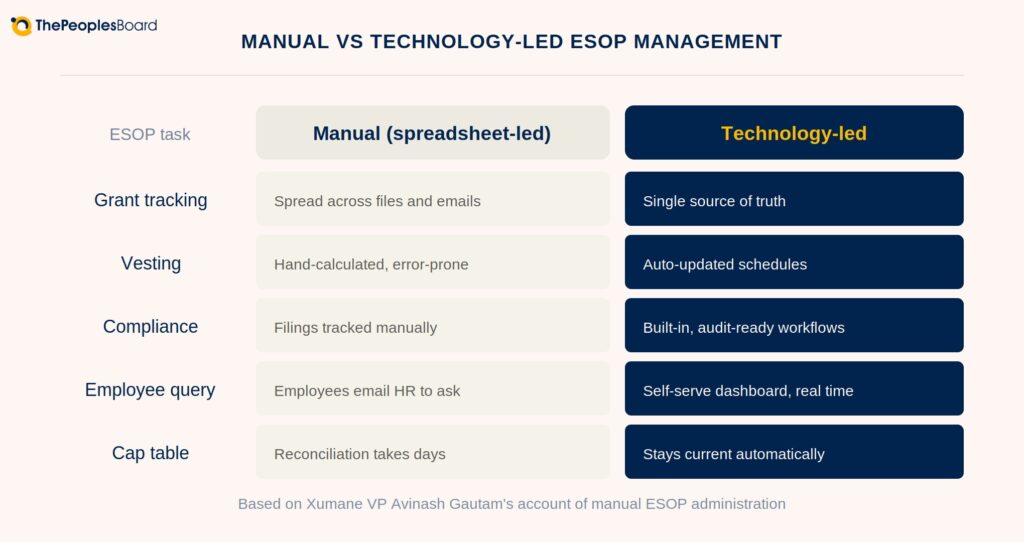
The pain shows up differently depending on what stage a company is at, but the pattern holds:
| Manual (Spreadsheet-Led) ESOP Management | Technology-Led ESOP Management |
| Grant data spread across files, emails, and board resolutions | Single source of truth for every grant, from allocation to exercise |
| Vesting calculated by hand, error-prone at scale | Vesting schedules calculated and updated automatically |
| Compliance filings (SH-6 registers, Companies Act resolutions) tracked manually | Compliance workflows built into the platform, audit-ready by default |
| Employees email HR to ask what they own | Employees see real-time vesting and value through a self-serve dashboard |
| Cap table reconciliation takes days during fundraising or audits | Cap table stays current automatically as grants and exercises happen |
The cost isn’t just time. It’s trust. When employees can’t get a straight answer about their own equity, ESOPs stop working as the retention tool they’re meant to be.
Making ESOP Distribution More Accurate and Transparent
This is where automation earns its keep. Instead of a person manually updating a grant tracker every time someone joins, vests, or exits, the system does it as the event happens.
“HR technology automates grant allocation, vesting calculations, and compliance while providing employees with real-time visibility into their ESOPs,” Gautam explains. “This reduces errors, builds trust, and ensures everyone has access to accurate information.”
In practice, this covers a fairly specific set of jobs:
- Grant allocation and documentation: Digital grant letters and maker-checker approvals replace ad hoc emails and physical sign-offs.
- Vesting and exercise tracking: Cliff periods, tranches, and exercise windows update automatically instead of relying on someone remembering to check a date.
- Compliance reporting: SH-6 registers, board resolutions under the Companies Act, and valuation records get generated and stored in one place, ready for an audit or a funding round.
- Employee-facing transparency: A dashboard showing vested value, unvested options, and exercise costs, so employees aren’t dependent on HR to answer basic questions about their own equity.
None of this is exotic technology. It’s largely workflow automation and a well-designed interface. But for a founder managing 200 employees across multiple funding rounds, or an HR team at a listed company managing thousands of RSU grants, that workflow automation is the difference between a two-day cap table cleanup and a five-minute report.
Where Automation Helps Most
Not every stage of the ESOP lifecycle needs the same level of tech intervention. Some parts are genuinely simple even on a spreadsheet. Others compound in complexity as headcount and funding rounds add up.
“The biggest benefits come from automating grant management, vesting tracking, compliance, reporting, and employee communication,” Gautam notes. “Automation saves time, improves accuracy, and creates a seamless experience for both HR teams and employees.”
| ESOP Lifecycle Stage | Where Manual Processes Struggle | What Automation Fixes |
| Plan design and pool sizing | Modelling dilution across scenarios by hand is slow and error-prone | Instant modelling of pool size, dilution, and funding-round impact |
| Grant issuance | Physical or emailed grant letters, inconsistent documentation | Digital, templated grants with audit trails |
| Vesting tracking | Manually recalculating schedules for every hire, exit, or pool refresh | Automatic recalculation as headcount and terms change |
| Exercise and taxation | Employees confused about perquisite tax and TDS obligations | Personalised, real-time tax and payout estimates per employee |
| Compliance and reporting | Scrambling to produce SH-6 registers or valuation reports during audits | Always-on, audit-ready compliance documentation |
| Liquidity events (buybacks, secondary sales) | Reconciling who’s eligible and at what price, often across spreadsheets | Automated eligibility checks and payout calculations |
The takeaway isn’t that every company needs the most sophisticated platform on day one. It’s that the parts of the ESOP lifecycle involving repeated calculations, compliance documentation, and employee-facing questions are exactly the parts that scale badly on spreadsheets and scale well on purpose-built HR automation.
India’s ESOP Technology Landscape
India’s startup ecosystem has produced a specific category of HR tech built around this problem: ESOP and cap table management platforms. Qapita, headquartered in Singapore with a large India presence, and Xumane (formerly Vega Equity), based in Noida, are two examples of India-native players in this space, alongside global cap table tools that some larger Indian companies use for cross-border equity plans.
None of these platforms replaces compensation management as a discipline. They automate the operational layer underneath it: grant tracking, vesting logic, compliance documentation, and employee communication.
What matters for HR and finance teams evaluating this category is whether a platform handles SEBI and Companies Act compliance out of the box, supports the specific equity instruments a company uses (ESOPs, RSUs, SARs, or phantom stock), and gives employees a clear, self-serve view of their own equity.
The urgency behind this shift is visible in real time. Flipkart’s second ESOP liquidity event, approved in 2026 at ₹713.4 per option, involves tracking eligibility and vesting across thousands of employees. That kind of scale simply isn’t manageable on a spreadsheet without significant risk of error.
Compliance And Data Considerations
Automating ESOP distribution doesn’t remove the compliance work; it just makes it easier to keep up with. Companies still need to maintain SH-6 registers and get shareholder approval for option pool changes under the Companies Act, 2013.
Listed companies also have SEBI rules on insider trading and disclosure timelines. A digital platform doesn’t erase these obligations, but it does keep the paperwork ready instead of scrambled together at the last minute.
There’s a data side to this too. ESOP records hold sensitive details like salary-linked tax data, bank information, and KYC documents, all covered under the Digital Personal Data Protection Act.
Before choosing a platform, it’s worth asking a few plain questions: who can see this data, is access logged, and does the contract clearly state who’s responsible if something goes wrong? If a vendor can’t answer those simply, the risk hasn’t gone away. It’s just harder to see.
In the End…
Manual ESOP management doesn’t fail because HR teams are careless. It fails because spreadsheets weren’t built to handle vesting logic, compliance documentation, and employee trust all at once, at the scale India’s startups and listed companies are now operating at.
The shift to HR tech-led equity management isn’t about chasing a shinier dashboard. It’s about closing the gap between how fast companies are granting equity and how reliably they can account for it. When that gap closes, employees get a straight answer about what they own, and HR teams stop spending audit season reconstructing a year’s worth of grants from memory.
That’s a fair trade, and it’s one more Indian companies are making every quarter.