
Hybrid work has moved from a pandemic-era compromise to a permanent fixture of India’s workplace. Yet the data tells an uncomfortable story: employees who work in hybrid mode are not necessarily the most engaged, and Indian organisations are being forced to rethink engagement strategies that once relied on physical presence.
According to ADP Research’s People at Work 2025 report, engagement in India fell to 19% in 2025, down from 24% the previous year, marking the steepest decline of any region tracked in the study. This is happening even as hybrid work becomes more entrenched across Indian industries, from IT services to BFSI. The gap between how much flexibility employees are getting and how engaged they feel is the central tension HR leaders now have to manage.
What The Data Shows
The ADP survey, based on responses from nearly 38,000 working adults across 34 markets, offers a granular view of how work location correlates with engagement in India.
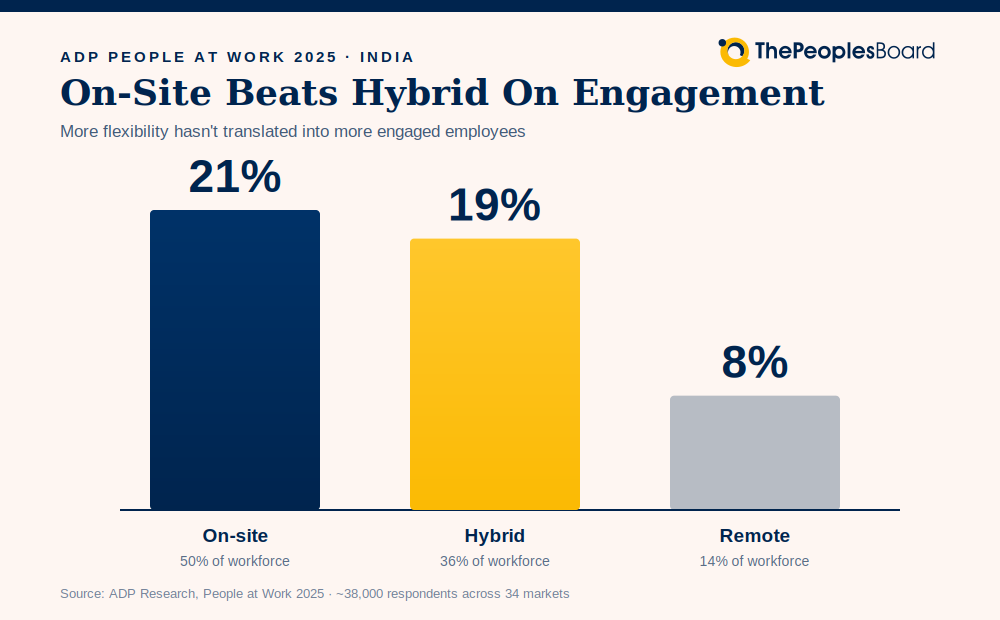
This runs counter to the assumption that flexibility automatically drives engagement. On-site employees in India report higher engagement than their hybrid counterparts, even though hybrid employees enjoy considerably more autonomy. India ranks second globally, after Egypt, on the share of employees who report full control over where they work, at 45%.
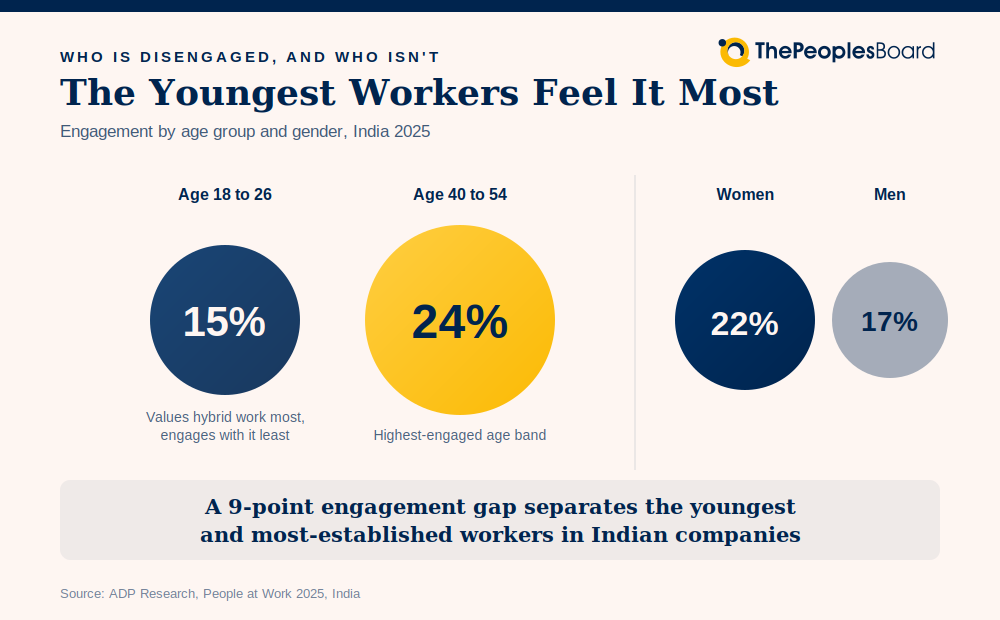
Age also plays a role. Workers aged 40 to 54 report the highest engagement at 24%, while those aged 18 to 26, the group most likely to value hybrid arrangements, report the lowest at 15%. Gender shows a similar contrast, with women reporting higher engagement (22%) than men (17%).
On-Site Workers v/s Hybrid Employees
The explanation is less about location and more about belonging. ADP’s research links engagement closely to whether employees feel part of a high-performing team. Only 33% of Indian workers currently report being part of the best team they have worked on, a figure that has declined by three percentage points year on year.
Rahul Goyal, Managing Director of ADP India and Southeast Asia, pointed to this connection directly. Flexibility and belonging both shape how engaged employees feel, and “employees who feel connected, valued, and empowered are significantly more engaged.”
For hybrid teams, that sense of connection is harder to build by default. Informal mentoring, spontaneous problem-solving, and the small interactions that build trust do not happen automatically when teams are split between home and office.
This is consistent with what several Indian companies have already concluded. Firms such as Infosys have tightened in-office requirements, framing the move around mentoring and collaboration rather than productivity monitoring. Deloitte’s return-to-office mandate for its India workforce followed a similar logic, tying attendance to performance evaluations.
Cost Of Disengagement For Indian Organisations
The financial stakes of getting this wrong are significant. Gallup’s State of the Global Workplace 2026 report found that India’s employee engagement hit a four-year low in 2025, and estimated the resulting productivity loss at 351 billion dollars, close to 9% of the country’s GDP.
Part of this decline is tied to how hybrid work has reshaped management itself. Gallup’s research also points to a sharp drop in manager engagement worldwide, and South Asia, primarily India, recorded the steepest regional fall, an eight-point decline in a single year. Fewer engaged managers, spread across hybrid teams that meet less frequently in person, compound the disengagement problem rather than solving it.
Indian Employers’ View on Hybrid Work and Retention
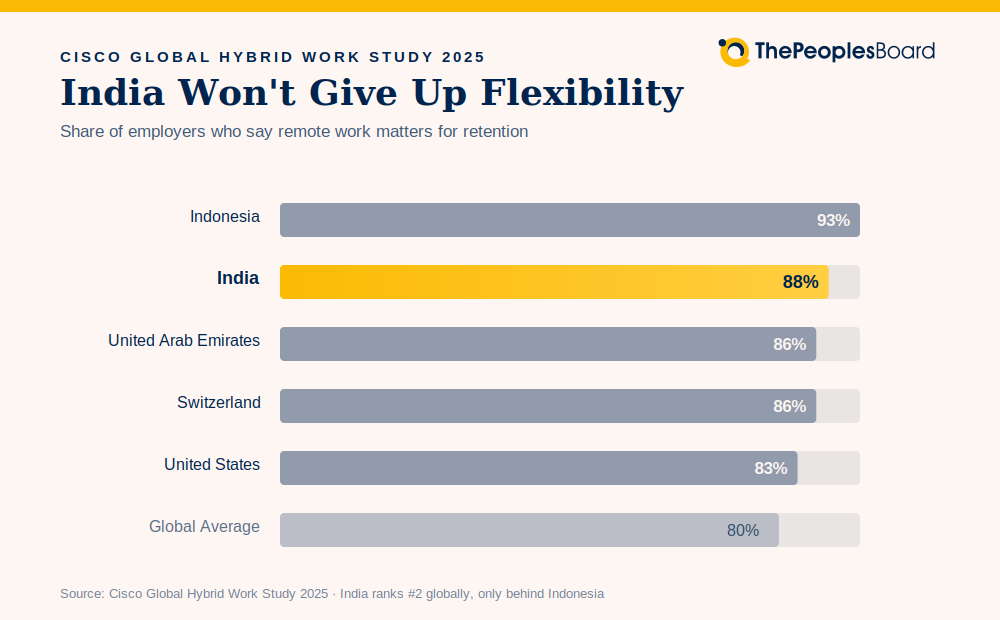
Despite the engagement gap, employers have not backed away from flexibility as a retention lever. Cisco’s Global Hybrid Work Study 2025 found that Indian employers rank remote work importance for retention higher than almost any other market surveyed.
The same study found that most employers believe consistent office attendance supports a healthy culture and innovation, creating a policy contradiction many Indian HR teams are still navigating. Organisations want employees in the building for culture and mentoring, but they also know flexibility is what keeps people from leaving.
Engagement Strategies For a Hybrid Workforce
Given this, engagement strategies built around office perks, town halls, or annual surveys are no longer sufficient on their own. HR teams across India are shifting toward approaches designed specifically for split-location teams.
- Anchor days over blanket mandates. Rather than fixed weekly attendance rules, some organisations are designating specific days for team-wide collaboration, reserving the rest of the week for flexible work.
- Manager capability building. Since manager engagement has declined sharply, training managers to run effective hybrid check-ins and recognise disengagement early has become a priority area.
- Outcome-based performance measurement. Presence-based management does not translate well to hybrid teams. TPB’s coverage of outcome-based performance frameworks in India outlines how organisations are shifting from hours-based tracking to OKRs and KPIs suited to distributed work.
- Deliberate belonging initiatives. Structured onboarding buddies, cross-location mentoring, and regular in-person team rituals are being used to rebuild the sense of “best team” that ADP’s data links directly to engagement.
- Technology for connected experience. Employee Experience Platforms are being adopted to unify communication, recognition, and feedback across in-office and remote employees.
What HR Teams Can Do Differently
The data points to a specific kind of failure, not a general one. Engagement is not falling because employees dislike hybrid work; it is falling because the systems meant to support hybrid work, from manager capability to team belonging, have not kept pace with how quickly the model was adopted.
That distinction changes what HR should actually fix. Broad, feel-good engagement campaigns are unlikely to move a metric that is declining for structural reasons: fewer engaged managers, thinner team cohesion, and a younger workforce that is disproportionately disengaged despite valuing flexibility the most. The shifts below target those specific gaps rather than engagement in the abstract.
- Measure engagement separately for on-site, hybrid, and remote cohorts, since a single company-wide score can mask where the real problem lies.
- Invest in manager training before adding new engagement tools, since manager engagement is the steepest-declining metric in India.
- Treat younger employees as a distinct engagement segment, given that 18-to 26-year-olds report the lowest engagement despite valuing flexibility the most.
- Build in structured, recurring in-person touchpoints rather than leaving collaboration to chance.
- Track attrition risk by work mode, not just by role or tenure, to catch disengagement before it turns into resignations.
In The End…
Hybrid work has not simplified employee engagement in India. It has made it more segmented, more dependent on manager quality, and more reliant on deliberate design rather than office culture happening by default.
The data is clear that flexibility alone does not guarantee engagement, and in some cases, hybrid employees report feeling less connected than those working entirely on-site. The task ahead is not choosing between flexibility and belonging, but building engagement strategies that account for both, tailored to how, where, and with whom people are actually working.
FAQs
Why is employee engagement falling in India despite hybrid work becoming more common?
Engagement is falling because hybrid work has outpaced the systems meant to support it. Manager capability, team cohesion, and structured belonging haven’t kept up with how quickly hybrid models were adopted, so flexibility alone hasn’t translated into stronger engagement.
Do on-site employees in India report higher engagement than hybrid employees?
Yes. ADP’s People at Work 2025 report found on-site employees in India report 21% engagement compared to 19% for hybrid employees and just 8% for fully remote employees, even though hybrid workers have significantly more autonomy.
Which age group has the lowest employee engagement in India?
Workers aged 18 to 26 report the lowest engagement at 15%, despite being the group most likely to value hybrid work arrangements. Workers aged 40 to 54 report the highest engagement at 24%.
How much is disengagement costing Indian organisations?
Gallup’s State of the Global Workplace 2026 report estimates that disengagement costs India’s economy 351 billion dollars in lost productivity, close to 9% of the country’s GDP.
Why do Indian employers still prioritise remote work for retention despite the engagement gap?
Cisco’s Global Hybrid Work Study 2025 found that 88% of Indian employers say remote work is important for retention, the second-highest share globally after Indonesia. Employers see flexibility as a retention lever even as they work to fix engagement separately.
What can HR teams in India do to improve engagement in hybrid teams?
HR teams can measure engagement separately by work mode, invest in manager training, treat younger employees as a distinct segment, build structured in-person touchpoints, and track attrition risk by work mode rather than relying on broad, company-wide engagement campaigns.