
According to a Josh Bersin Company study of highly granular profiles of over 25,000 CHROs, 86% say their role is changing “significantly” or “dramatically.” That’s a global number. But look at what’s happening in India specifically, and the shift feels even sharper.
In 2024 alone, 27% of BSE 100 companies appointed a new CHRO, and it’s more than three times the global average of 8%, according to Russell Reynolds Associates’ analysis of BSE 100 companies. And these aren’t lateral moves.
Pidilite Industries brought in Ashish Prasad as CHRO with a mandate centred on leadership development and cultural transformation. Adventz Group hired Supratik Bhattacharyya, formerly Chief Talent Officer at RPG Group, to oversee HR strategy across its businesses, while Bajaj Finserv promoted Anupam Sirbhaiya as Group CHRO as it continues to scale. Welspun Corp appointed Rakesh Mehta to lead global people strategy with a focus on leadership depth.
None of these is a traditional HR appointment. They’re business appointments that happen to sit in HR. And the people stepping into these roles are rising to the challenge.
So what’s actually changed? And why should HR professionals feel optimistic about where the CHRO role is headed?
Why the CHRO Role in India Is No Longer About HR Operations
The CHRO in an Indian organisation today isn’t the person who manages payroll disputes and approves leave policies. That work still exists, but it’s been pushed down to HR business partners and automated through platforms like Darwinbox and Keka.
What’s moved up to the CHRO’s desk is different. It’s an AI strategy. Workforce redesign. Cultural integration after mergers. Skills architecture for roles that didn’t exist two years ago. The shift isn’t about HR getting a fancier title.
It’s about businesses recognising that their biggest operational risk, talent readiness, needs a C-suite owner with real authority. And increasingly, Indian organisations are giving CHROs exactly that.
Gartner’s survey backs this up. Leader and manager development has held the top spot on CHRO priority lists for three consecutive years now. But in 2026, it shares space with AI strategy and workforce redesign in ways it never did before.
Korn Ferry’s 2025 CHRO Survey of 756 HR leaders across 50+ countries found that growth and market expansion have increased as a CHRO priority by 25% over the past two years. More than a third of CHROs globally now spend the majority of their time leading transformation efforts rather than managing operations.
The mandate has expanded, and Indian CHROs are not just responding. They’re leading.
From Support Function to Strategy Table: What Indian CHROs Are Actually Doing
Lakshmi Chandrasekharan, Senior Managing Director and CHRO at Accenture in India, frames the opportunity in structural terms. In a Business Today deep dive (April 2026), she argued that CHROs need to move beyond existing organisational structures and redesign work by deconstructing jobs into tasks, figuring out where human judgment and creativity add unique value, and where AI can take over. At Accenture India, work redesign isn’t a side project. It’s the starting point. And it’s paying off.
That perspective isn’t isolated to IT services. Aarti Srivastava, CHRO for India at Capgemini, described how HR at her company works closely with business leaders to anticipate capability needs and embed continuous learning.
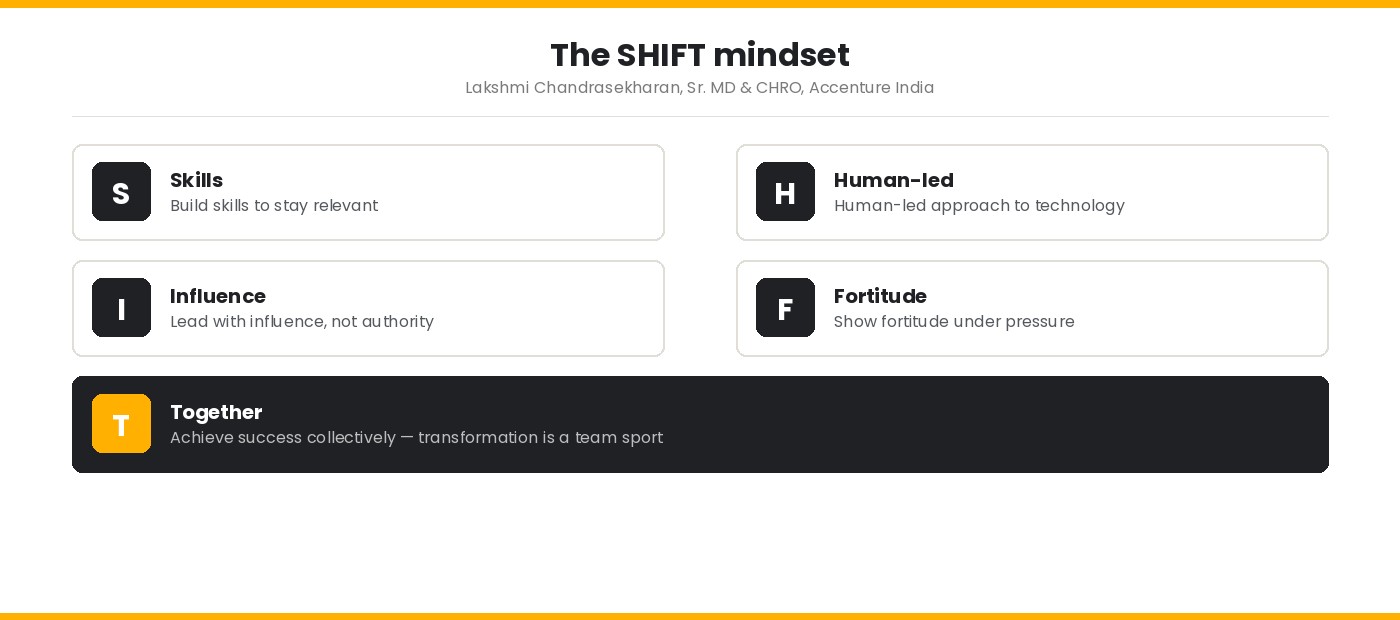
The words she uses stand out; she doesn’t talk about “supporting” business leaders, but about working alongside them to ensure talent strategies evolve as quickly as technology does. Capgemini’s SHIFT mindset framework is about Skills, Human-led, Influence, Fortitude, Together. It has become a practical blueprint for this kind of strategic HR leadership.
Chandrasekhar Sripada, Clinical Professor at the Indian School of Business, puts it more directly. He observed that the role of the CHRO has already become that of a co-pilot in progressive Indian organisations, with many companies treating the CHRO as a co-owner of business strategy and execution.
And this isn’t just anecdotal. According to Gartner’s 2026 CHRO Priorities research, organisations that successfully embed culture into day-to-day work see up to a 34% increase in employee performance. That’s the kind of business outcome that earns CHROs not just a seat at the table, but genuine influence over where the company goes next.
The CHROs who’ve crossed over to the strategy table got there by demonstrating measurable business value by showing how Agentic AI is reshaping HR’s role, through talent architecture, and through workforce planning that directly connects to revenue outcomes. And in India’s current environment, more of them are making this leap than ever before.
The Three Forces Creating Unprecedented Opportunity for Indian CHROs
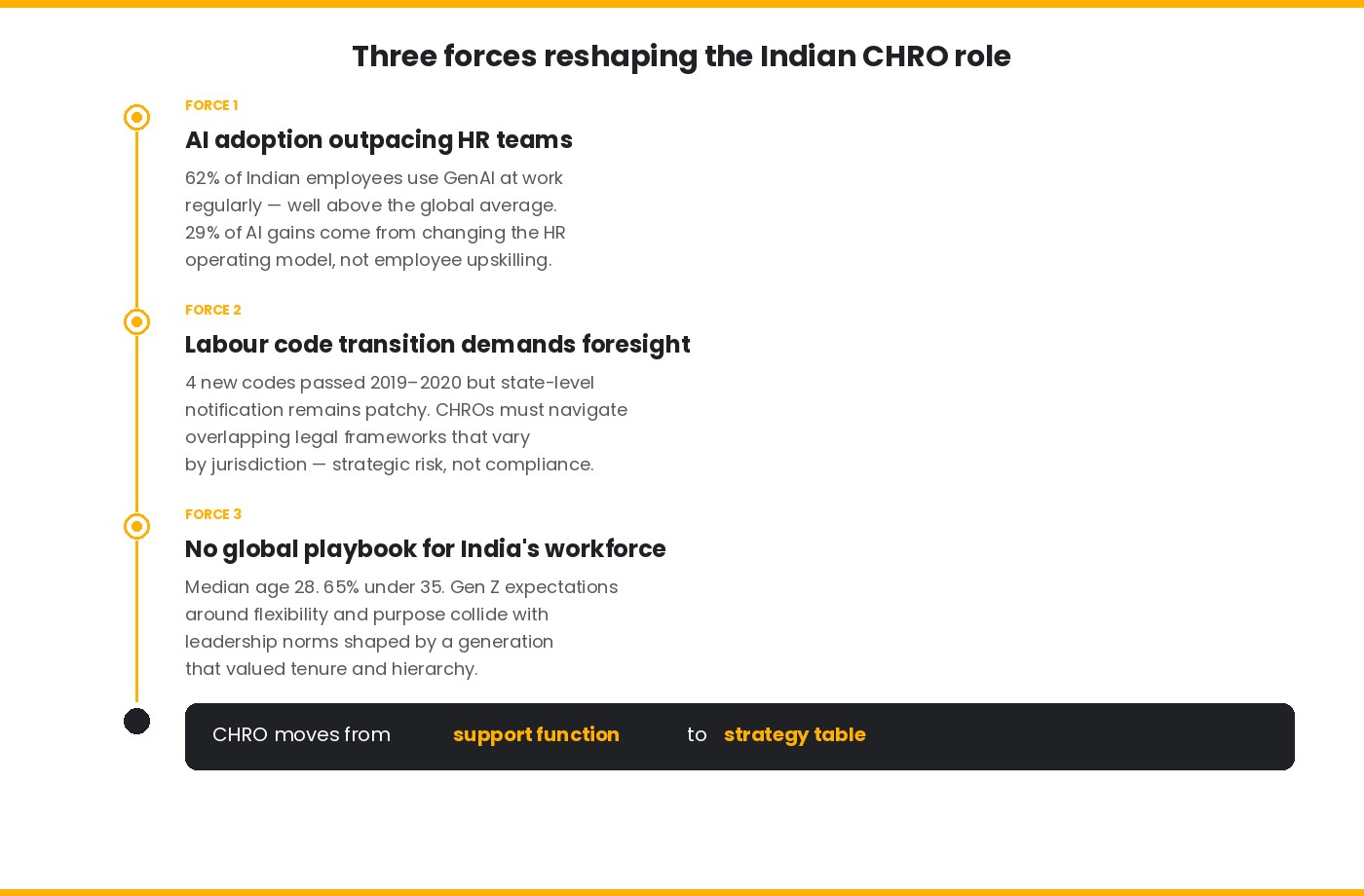
Three structural forces are accelerating this shift in India specifically. They’re not just pressures, they’re opportunities that position CHROs at the centre of business strategy in ways that no other C-suite role can match.
1. AI Adoption Is Creating a CHRO-Shaped Opportunity
EY’s 2025 Work Reimagined Survey shows that India leads the global AI Advantage Index, with 62% of Indian employees regularly using GenAI at work, which is well above the global average.
Meanwhile, Korn Ferry’s Workforce 2025 survey found that employees in India are among the global leaders in AI training adoption, significantly outpacing their counterparts in Western markets.
For CHROs, this isn’t a threat. It’s a once-in-a-generation chance to own a transformation that touches every part of the business. Gartner’s research found that nearly 29% of AI-driven productivity gains come from changes to the HR operating model itself, rather than from improving employees’ AI skills or awareness.
McKinsey’s 2025 State of AI research shows that 88% of organisations globally are now using AI regularly. However, the gap between pilots and real business impact often comes down to people issues: training, change management, and workforce planning. That’s CHRO territory.
As per BCG, more than 80% of AI investments go toward redesigning core functions and launching new offerings, not just cutting costs.
The CHROs who architect this human-AI integration are building the competitive advantage their companies will run on for the next decade.
2. India’s Labour Code Transition Demands the Strategic Mind That CHROs Bring
India’s Labour Codes on Wages, Social Security, Industrial Relations, and Occupational Safety were passed between 2019 and 2020. But state-level notification remains patchy and inconsistent. For CHROs, this creates a dual challenge: preparing for compliance with codes that aren’t fully in effect, while managing existing obligations under the old Acts.
This isn’t administrative complexity. It’s a strategic risk, and CHROs are uniquely positioned to manage it. A CHRO at a multi-state manufacturer or a fast-scaling startup with employees across 10 states needs to translate regulatory uncertainty into workforce-planning decisions, not just compliance checklists. The ones who do this well are becoming indispensable to their leadership teams.
3. India’s Multigenerational Workforce Is a CHRO’s Competitive Edge
India’s median age is 28. About 65% of the population is under 35. That means Gen Z expectations around flexibility, purpose, and career progression are colliding head-on with leadership norms shaped by a generation that valued tenure and hierarchy.
There’s no Western playbook for this. But that’s precisely why it’s an advantage for Indian CHROs. Korn Ferry’s survey data shows that more than 60% of employees would stay in a job they dislike if it offered rapid upskilling opportunities.
CHROs who can design learning pathways, career architectures, and culture frameworks for this uniquely young, ambitious workforce are solving a problem no one else in the C-suite can. Those planning a career path to the CHRO role should recognise that managing this multigenerational complexity isn’t a burden; it’s the skill that will define the next generation of business leaders.
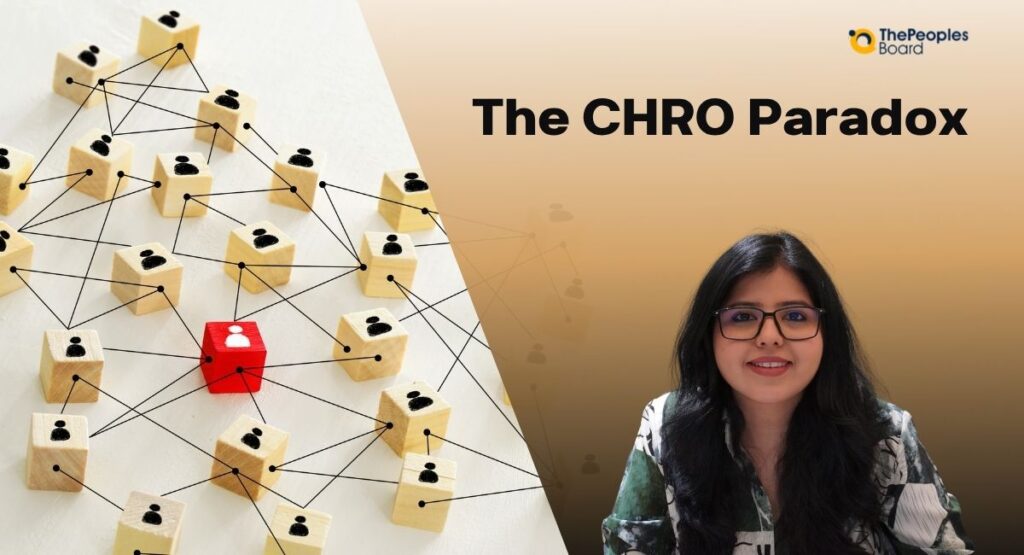
The CHRO Paradox And How Indian Organisations Are Solving It
Here’s the tension that deserves honest acknowledgement.
The Josh Bersin Company studied over 25,000 CHRO profiles and surveyed 200 CHROs directly. Their finding: average CHRO tenure has dropped from 6 years to 4.8 years. Only 12% of CHROs rank among the top five highest-paid executives at their companies, despite 60% seeing themselves as equal to other C-suite leaders.
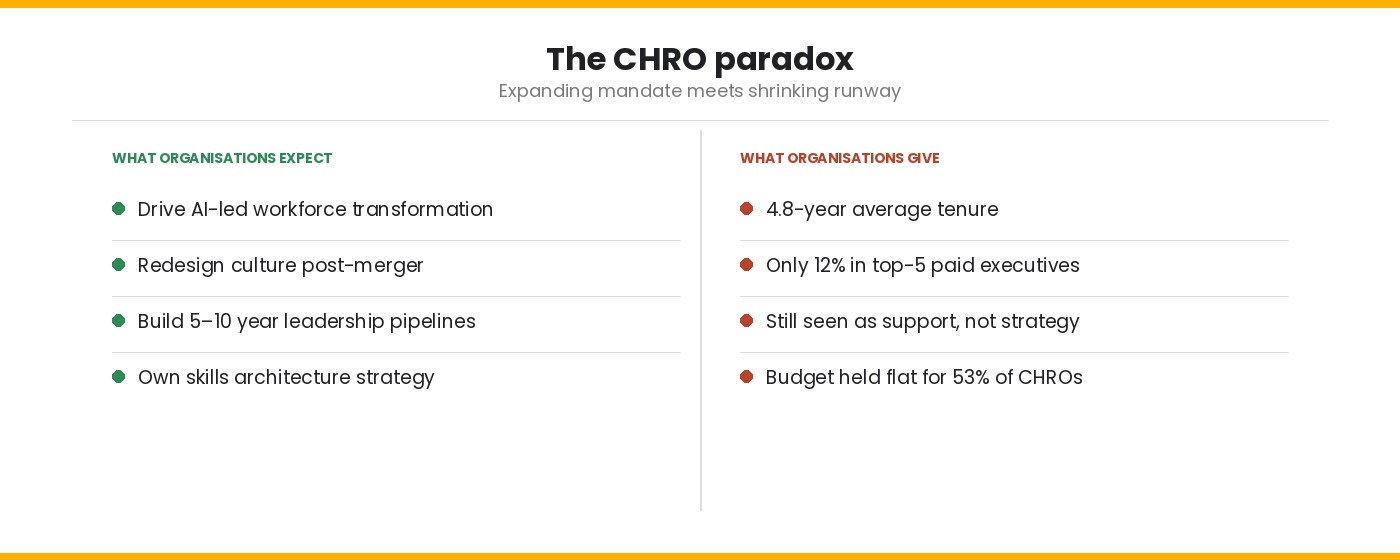
The Talent Strategy Group’s 2025 CHRO Trends Report adds another dimension: among Fortune 200 companies, CHRO turnover hit 15.5% in 2024, a 36% increase year over year, with 30 new CHROs collectively overseeing more than 2 million employees and $1.5 trillion in annual revenue.
In India, this paradox has its own texture. Russell Reynolds Associates found that more than half the CHROs in BSE 100 companies have changed jobs in the past 3.5 years. And 56% of 2024 BSE 100 CHRO appointments were external hires compared with just 39% globally, suggesting that many Indian companies are actively seeking fresh perspectives and proven transformation experience.
But here’s the encouraging part: Indian organisations are increasingly solving this paradox by giving CHROs real mandates, not just titles.
- Bajaj Finserv’s internal promotion of Sirbhaiya signals continuity and institutional knowledge.
- Tata Consultancy Services elevated Sudeep Kunnumal, a 25-year veteran who led HR for the BFSI vertical and spearheaded global talent integration, showing that deep domain expertise is valued.
- Nestlé India brought in Nitu Bhushan from Pernod Ricard with over two decades of cross-sector experience. Zepto appointed Sneha Arora as CHRO with an explicit brief to build a culture grounded in trust as the company scales.
These are not cosmetic appointments. They’re strategic bets on the CHRO as a growth driver. And the CHROs stepping into these roles are delivering.
What This Means for HR Professionals Aspiring to the C-Suite
If you’re a mid-career HR professional watching this evolution, the path forward has never been clearer or more exciting.
Sripada at ISB identifies three capabilities that matter most now: deep understanding of the business (not just the people function), enterprise-wide thinking that connects talent decisions to commercial outcomes, and the ability to sense changes in the external environment in real time. Chandrasekharan at Accenture India presents the SHIFT mindset, Skills, Human-led, Influence, Fortitude and Together, as a practical daily framework.
The Talent Strategy Group’s 2025 data offers a useful map: the HR Business Partner path remains the most common route to the CHRO role, with every two HRBP-origin appointments matched by one from a Centre of Excellence background (Talent Management, HR Strategy, or Total Rewards). Among 2024 Fortune 200 CHRO appointees, 93% had prior HR experience, and 47% had also held roles outside HR — in operations, finance, or strategy.
Globally, 80% of new CHRO appointments in Fortune 200 companies in 2024 were women, the highest proportion since tracking began in 2017. In India, the picture is different. Russell Reynolds notes that 76% of BSE 100 CHROs are men, but this gap itself represents an enormous opportunity for women HR leaders ready to step up.
None of these is a traditional HR competency. And that’s exactly the point. The shift from HR professional to business leader requires fluency in commercial strategy, comfort with AI and data, and the willingness to own outcomes that go well beyond headcount and attrition. The good news? Indian HR professionals are already building these muscles faster than many of their global peers.
The CHRO Moment Is Here
The CHRO role in India has reached an inflexion point, and it is already playing out. CHROs are leading AI transformation, shaping workforce strategies, and turning regulatory complexity into business advantage, while proving that people strategy is business strategy.
This shift is backed by data. Gartner highlights that strong culture-led approaches can improve performance by 34%, while Korn Ferry notes a 25% rise in focus on growth and market expansion. More CHROs are now spending the majority of their time on transformation, reflecting their growing business impact.
For HR professionals, this is a defining moment. The skills being built today in talent strategy, AI adoption, and navigating India’s landscape are exactly what businesses need, making this one of the most important times to be in the profession.
FAQs
What does a CHRO do in Indian companies in 2026?
Indian CHROs in 2026 are responsible for AI-driven workforce transformation, cultural redesign, leadership pipeline development, and aligning talent strategy with business growth objectives. According to Gartner, embedding culture effectively can drive up to a 34% increase in employee performance. The role extends well beyond traditional HR operations like payroll, compliance, and recruitment.
Why is the CHRO role changing in India?
Three India-specific forces are driving the change: rapid AI adoption (62% of Indian employees use GenAI at work, per EY’s 2025 survey), a complex and evolving labour code transition at the state level, and a multigenerational workforce with a median age of 28. Russell Reynolds Associates found that 27% of BSE 100 companies appointed a new CHRO in 2024 alone — more than three times the global average.
What skills do you need to become a CHRO in India?
Beyond core HR expertise, aspiring CHROs need business strategy fluency, AI and data literacy, regulatory foresight across India’s multi-state framework, and the ability to connect talent decisions to revenue and growth outcomes. The Talent Strategy Group’s 2025 data shows the HRBP path is the most common route, and 47% of Fortune 200 CHROs have also held roles outside HR. The Indian School of Business identifies enterprise-wide thinking and environmental sensing as critical differentiators.
How long does the average CHRO stay in their role?
Average CHRO tenure globally has dropped from 6 years to 4.8 years, according to The Josh Bersin Company. In India, more than half of BSE 100 CHROs have changed roles in the past 3.5 years (Russell Reynolds Associates, 2025). However, organisations are increasingly addressing this by providing CHROs with clearer transformation mandates and stronger board-level support.
Is this a good time to pursue a CHRO career in India?
Absolutely. CHRO turnover in India’s top companies is at record levels, creating more openings for ambitious HR leaders. The role now carries genuine business influence, with CHROs leading AI strategy, workforce redesign, and cultural transformation. For HR professionals building skills in these areas, the career trajectory has never been stronger.