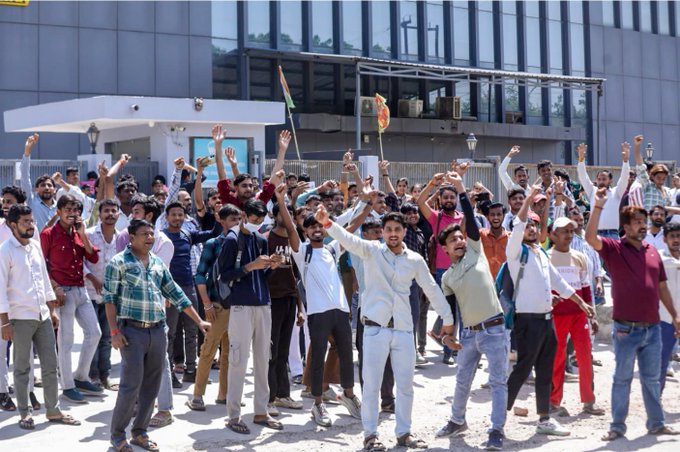

Factory workers in Noida’s Phase 2 industrial area launched a four-day wage protest this week that turned violent on April 13, with vehicles torched, stones pelted, and tear gas deployed by police, forcing the Uttar Pradesh government into emergency overnight talks with labour representatives.
The unrest, centred across Sector 60, Sector 62, Sector 84, and surrounding industrial hubs, brought manufacturing activity in one of Asia’s largest planned industrial townships to a near standstill. Around 300 people have been arrested in connection with the violence, with seven FIRs registered so far.
At the heart of the protests is a straightforward demand: a minimum monthly wage of ₹20,000, against the current ₹13,000–₹15,000 that workers say barely covers rent, food, and rising fuel costs. Workers also want eight-hour shifts (mandatory 12-hour shifts are common across units in the Hosiery Complex), weekly offs, double overtime pay, and clearance of pending salary arrears.
The immediate trigger was Haryana’s decision to raise its minimum monthly wage for unskilled workers by 35%, from ₹14,000 to ₹19,000. That ₹6,000 gap between what a worker earns in UP versus a counterpart doing identical work across the state border became the flashpoint. Banners at several Noida factories explicitly demanded wage structures on par with those in Manesar.
“We work 12–16 hours, but don’t get proper benefits. We want a minimum salary of ₹20,000–₹25,000 and double overtime without deductions,” workers told reporters at the protest site. One woman worker put it plainly: “Even basic needs are difficult to meet. Prices are the same for everyone, but our salaries are not.”
The state government moved quickly after the violence escalated. Noida District Magistrate Medha Roopam held a virtual meeting with the Principal Secretary (Labour) and the UP Labour Commissioner on Sunday to discuss overtime, bonuses, weekly holidays, and workplace safety. Late-night talks between labour representatives and a high-level UP government committee followed on Monday. Police Commissioner Laxmi Singh said four of the five workers’ demands had been accepted, with a committee constituted to address the remaining issue.
UP Chief Minister Yogi Adityanath said every worker deserves a fair salary, a safe working environment, and basic facilities, and directed industrial units to comply with labour laws. UP Labour Minister Anil Rajbhar described the violence as a “well-planned conspiracy” and said authorities were investigating possible external instigation. Police also said “outsiders” had attempted to incite unrest again after workers had dispersed peacefully and were being identified for action.
The protests have raised broader alarm in the NCR industrial ecosystem. The Tribune quoted Atul Mukhi, president of the Manesar Industrial Association, saying even workers themselves feel unsafe, particularly women employees, amid the volatile atmosphere. Industry stakeholders have called for faster restoration of law and order to protect manufacturing continuity and investor confidence.
Labour unrest in Noida mirrors a pattern playing out across India’s industrial belt. Similar protests in Manesar last week also prompted the Haryana government to announce a wage revision. With the UP government now under pressure to act on minimum wage disparity, the outcome of the current talks could set a precedent for factory workers across the state.