
“Please be aware that students are not allowed to leave on short leaves.”
“Do not follow someone, even a kid, if they are asking for help.”
“Have you locked the doors?”
“Come back home sooner.”
“Haven’t you heard the news?”
People across Delhi and NCR did hear the news. When 800 people are reported as missing, 500 among them being women, within 15 days, it becomes very hard to ignore. The numbers grew increasingly alarming as news outlets and social media influencers demanded answers.
Ultimately, the Delhi police did come up with an answer. An answer that made the panicked Delhi-NCR feel both cheated and horrified.
After following a few leads, we discovered that the hype around the surge in missing girls in Delhi is being pushed through paid promotion. Creating panic for monetary gains won’t be tolerated, and we’ll take strict action against such individuals.
— Delhi Police (@DelhiPolice) February 6, 2026
“After following a few leads, we discovered that the hype around the surge in missing girls in Delhi is being pushed through paid promotion. Creating panic for monetary gains won’t be tolerated, and we’ll take strict action against such individuals,” Delhi Police stated on X.
The Normalcy of it All
The sobering part of the Delhi Police’s statement was the fact that there have been that this high number of missing people is not out of the norm. That 807 people going missing in 15 days and that 1,777 going missing in all of January 2026 is par for the course.
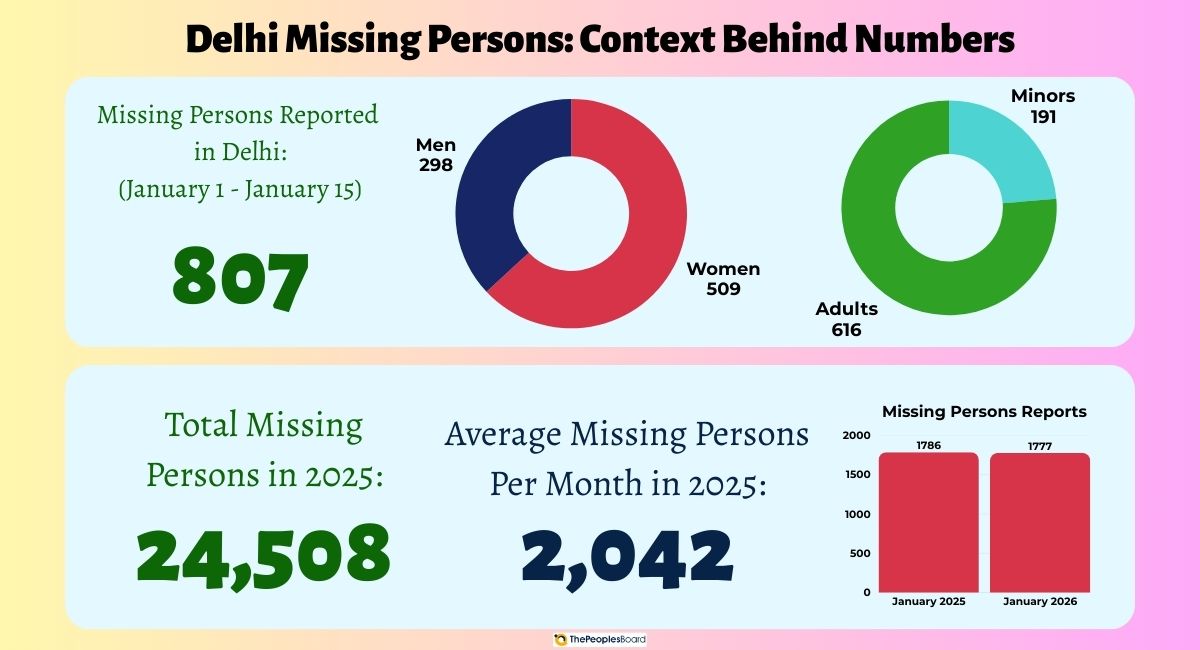
In fact, the Delhi Police admitted the numbers for January 2026 are actually lower than the monthly average of 2025. Even year-over-year, 1,786 missing persons cases were reported by the Delhi Police in January 2025.
Delhi Police explained that a total of 24,508 missing persons cases were recorded in 2025, for a monthly average of 2,042. This, strictly speaking, does make January 2026 an improved case with “proportionately lower” numbers. The Delhi Police also revealed in an X post that “in January 2026 alone, 629 missing persons were successfully traced.”
The data from 2016 to 2025 even shows an overall recovery rate of 77%, with 1,80,805 people having reunited with their families over the course of the decade.
In other words, the horrifying numbers making the rounds on the internet were not wrong, but they were, unfortunately, nothing new.
The Why and How of Panic
So, if the numbers were new, why were people across Delhi NCR panicked? The answer lies in how the number of missing people was presented as new rather than normal for the area.
That people go missing in Delhi NCR is not something its residents are unaware of, but the everyday citizen is also not familiar with the exact numbers.
As such, when those numbers started making the rounds on the internet, were repeated again and again by social media influencers, and were covered by news outlets, it created a sense of urgency.
After all, why would everyone be talking about missing people in Delhi unless there was a new development that might have led to an increase in missing people in Delhi? After all, why would the average numbers generate any news?
The impact of these circulating numbers was severe. Working parents became paranoid about their kids, especially whether or not they were safe with their caretakers or even in school.
Professional women, who often travel with extreme caution in Delhi, became even more paranoid, not trusting themselves to even the often-used public transport options.
People across Delhi began warning each other not to even step outside the house. Scenarios of possible kidnappings were imagined, and schools started issuing advisories to provide relief to parents and children alike.
The Bitter Honey Trap
The dilemma in the Delhi Police statement was that few knew what to do with it. After all, it was the numbers that were scary, and they did not change.
However, the fact that there wasn’t really any organised crime ring stepping up its operations in the capital region did provide some relief.
The Delhi Police’s strong condemnation of how the numbers were being circulated on the internet once again highlighted the importance of checking not just the sources of the news you come across but also the context behind it.
“Between January 1 and 15, a total of 807 people went missing, with an average of 54 people going missing every day. Of these, 509 were women and girls, and 298 were men.”
This was the statement repeated everywhere, without anyone stating at all that this was not higher than normal.
It is, in fact, no different than someone telling you in a very serious tone that your blood sugar is at 100 without mentioning that the number is perfectly normal for someone without diabetes or early signs of it. Without expertise or knowledge of normalcy, you end up relying on how the news is conveyed.
In case of the missing persons in Delhi, the numbers were shared as a warning, as a novel, as something to be scared of, and the people did get scared of it.
The Responsibility
Just who should be blamed for the fear that swept across Delhi NCR within days? Should it be the Delhi Police for not keeping the streets safer? Or should it be on the public for believing all that they see and hear?
Perhaps there is blame to go all around, but the lion’s share of it, in this case, is on those who repeated these numbers over and over again. After all, the panic came from how much the numbers were being discussed.
The journalists and public do have the responsibility of sharing facts and asking questions, but should this be done by scaring everyone who comes across it?
If the numbers had to be highlighted, why not reveal them all? Why not ask why the number of still missing women in Delhi has risen to 5,576 in 2025 from 1,606 in 2016? The numbers are still terror-worthy. They still demand answers.
But they do not create a sense of urgency that makes one think that the streets have suddenly become even more unsafe.
The way the numbers were presented disrupted many professional and personal lives. It shed light on an important topic, but in a way that left people terrified and later bitter.
Even with temporary reader traction, many publications and influencers lost an even more important commodity with this incident. The trust of the public. Something that is going to be much, much harder to gain back.