
- In 2023, a study conducted by ISG found that about 54% of the organisations did not achieve clear business value by adopting HR tech products.
- Yet another SHRM study found that 56% of HR leaders admitted their technology solutions don’t align with current and future needs
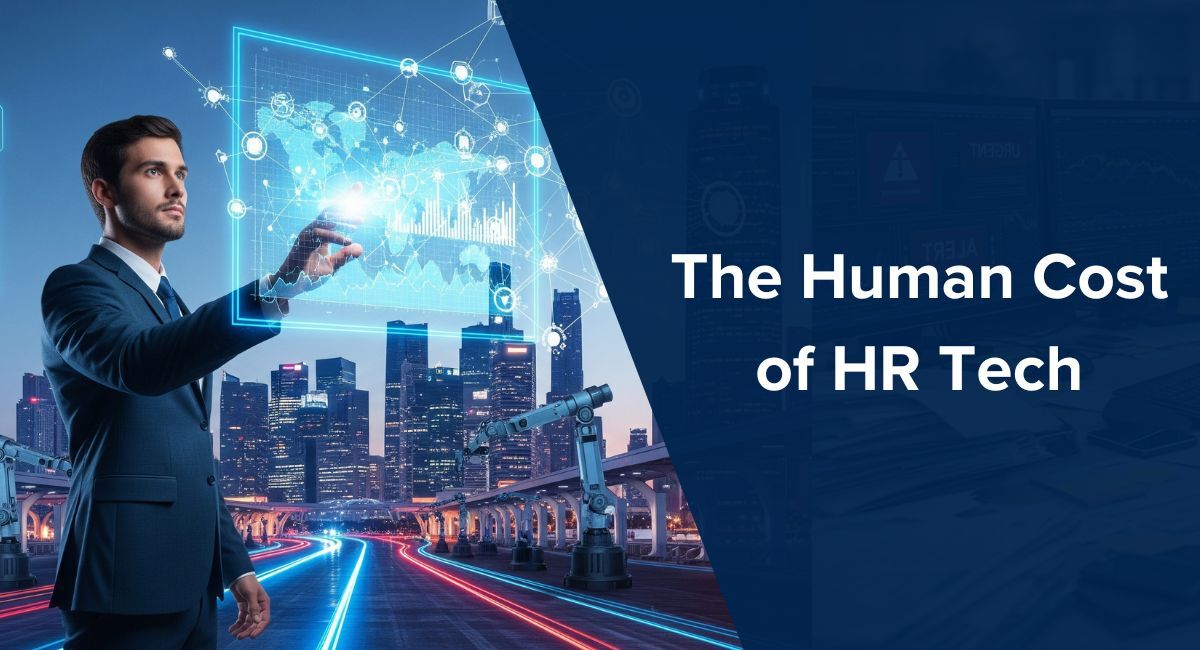
The HR dashboard starts blinking even before the rest of the workforce logs in. But does HR Tech fulfil all the talent management needs?
In this blog, ThePeoplesBoard aims to explore the limitations of HR Tech. But, to understand the limitations, it is highly important to understand what HR Tech is and what it is used for.
A previous blog about tech fatigue discussed how the Indian HR fraternity started adopting integrated HR Tech tools aggressively to manage the workplace remotely when the world shut down overnight due to the COVID-19 lockdown. Since then, the HR dashboard has been lighting up before the office does. Numbers move, graphs rise and fall, alerts blink in red and green. And, somewhere between those data are hidden the stress, hopes, ambitions, and doubts of the employees (including the HR professionals).
5 Problems – 1 Solution
- Remote talent management: As mentioned above, managing a remote workforce and ditching biometrics are among the first drivers of the widespread adoption of HR Tech. From attendance to documentation, HR Tech is almost the one-stop solution for HR.
- Onboarding: People have been using recruitment portals since nobody would have probably imagined that candidate scanning could be explored globally, from just one tiny corner of the world. But for the age-old portals, a lot of work after shortlisting required human labour. Today, with the advent of tech and innovation, such repeated activities have been automated. From skills matching to preliminary interview rounds, AI is driving all with newer HR Tech tools.
- Designing Learning Modules: The new generation of managers and HRs has understood that skills development needs to be highly customised to roles. Today, HRs learn through role-based recommendations, microlearning, and certification tracking. Employees gain flexibility in how and when they learn. However, learning sometimes becomes more about completion rates than true capability building.
- Skills Mapping: Skill frameworks and AI-driven assessments help organisations map current capabilities and future gaps. These help with reskilling strategies and internal mobility. Yet, they often reduce complex human potential into fixed labels and keyword-based classifications.
- Workforce Planning: Workforce planning tools forecast hiring needs, attrition risks, and organisational structure changes using data models. They help leaders prepare for future business demands. But unpredictable human behaviour and market shifts often challenge even the smartest projections.
In addition, today HR professionals depend on HR Tech for multiple purposes, including employee engagement, attendance, and employee internal mobility.
It is important to note that HR tech tools are highly efficient. It has succeeded exactly in what it was designed to do: organise, automate, measure, and scale. But any tool, for that matter, should be confined to automating and supporting repetitive tasks rather than entering the decision-making zone.
The problem begins when organisations expect it to understand, judge, and replace human complexity. This is where usefulness slowly turns into overdependence.
So how does overdependence affect the workforce?
In 2023, a study conducted by ISG found that about 54% of the organisations did not achieve clear business value by adopting HR tech products. The study stated that, “One reason for this is that HR buyer expectations have increased. Beyond improving the user experience, organisations are seeking improved functionality that translates directly to greater operational efficiencies, reduced cycle times and other measures of business value.”
Another factor widening the business value gap is organisations’ continued difficulty in keeping pace with the rapid evolution of HR technology. This is directly related to the dehumanising of employee experience. The moment an employee feels processed rather than supported, productivity takes a backseat
Yet another SHRM study found that 56% of HR leaders admitted their technology solutions don’t align with current and future needs
On that note, let’s take a look at where HR Tech fails:
- Privacy and data security: Like any other software, an HR Tech software runs on algorithms and requires data to deliver outcomes. With too much data being exposed to such tools and often maintained remotely, data privacy becomes a big concern.
Example: Tools used for compensation and benefits functions store sensitive and financial data of employees. A breach can put employees in a vulnerable position.
- Data influences decisions: When dashboards and data drive decisions, people facing real human challenges are often ignored and misjudged in the process.
Example: Even star performers have low days. Productivity often depends on the current mental health status of employees. This calls for a human interaction and empathy. Dashboards don’t record emotional factors. So, judging by the dashboard may not always give an accurate output.
- Disintegrated tools: HR tools are primarily designed for a specific industry. Multiple HR tools often fail to integrate smoothly. This creates confusion, duplication, and inconsistent employee experiences due to too much tab switching.
Example: Tool switching is a constant challenge in the HR automation process. While an employee marks attendance on one tool, he switches to another for learning purposes. It gives rise to fatigue and impacts productivity and time.
- Reduced manager accountability: Managers begin to depend on system outputs for people’s decisions. Personal judgment and ownership slowly decline.
Example: Unfortunately, in some cases, managers justify a poor appraisal by citing system-generated ratings, avoiding direct conversations and responsibility for the decision. This also leads to bias.
- Reduced informal feedback: The GenZ workers prefer feedback such as spontaneous appreciation and real-time coaching. Thus, keeping real-time human connections with them is necessary to keep them engaged.
Example: Daily interactions make more space for improvements. But an automated process leaves fewer chances for casual conversations and feedback, disengaging an employee.
Even with all the challenges with HR Tech, overcoming them wouldn’t mean abandoning the idea of digital transformation and process automation. The discussion about HR tech needs to shift to how to integrate it with human intelligence
SRHM suggests that the focus must remain on using technology to enhance rather than replace human connections in the workplace. Even as HR tools become commonplace, the fundamentals of listening, trust-building, and empathy remain integral for leaders seeking to nurture talent.
It is time for leaders to treat dashboards as references and starting points, and not as final verdicts. They also need to encourage managers to validate insights through real engagement with employees. Most importantly, HR tech strategies must be guided by culture, ethics, and empathy, so that technology strengthens human experience rather than quietly erodes it.
Going ahead
In the age of AI, HR Tech is inevitable. After all, it is difficult to ignore dashboards, algorithms, surveys, and systems. Tech shapes how a company hires, manages, and retains people. Yet trust, belonging, and motivation still depend on human connection
In the rush to stay competitive amid globalisation, HR started automating its processes. But the HR is not to be blamed. The need for efficient management of a remote and global workforce was what triggered the use of HR tools. But if taken a closer look, in a workforce where colleagues barely meet or know each other in person, a more human workforce management is required. That’s what has been overlooked. In line with this, a recent study by PeopleStrong found that even today, as many as 47% of organisations are using manual insights for developing workforce insights
This indicates that the real challenge ahead is not choosing between humans and technology, but restoring the balance between them. HR Tech was never meant to replace humans. But decision-makers rushed into too much automation to achieve global parity and stay competitive. Amid rapid digital transformation and remote workforce management, somewhere, human emotions lost the game to tech