For much of my career, organisational growth was easy to read. You looked at the numbers — headcount, new offices, hiring velocity, and you knew whether a company was expanding or contracting. Growth was visible, measurable and often celebrated through sheer scale.
Today, that lens feels increasingly outdated.
Recent workforce data from India’s top five IT services companies offers a quiet but powerful signal of how growth itself is being redefined. According to company filings compiled and reported in the media, the combined headcount of TCS, Infosys, HCL Tech, Wipro and Tech Mahindra stood at approximately 15.37 lakh employees in CY 2023. In CY 2024, this number declined modestly by around 2,500 employees, before inching back up by +2,505 in CY 2025, bringing the total almost exactly where it started.
On paper, this looks like stagnation. From an HR’s seat, it looks like something else entirely.
When Hiring Slowed, Capability Took Centre Stage
The pause in hiring during 2024 was not driven by panic. It was driven by prudence. Market uncertainty, changing client expectations and the rapid advancement of AI prompted leaders to slow down and reflect.
The key question quietly shifted from “How fast can we hire?” to “What capabilities do we truly need?”
This distinction matters. Headcount growth is easy. Capability growth is hard. It requires clarity, patience and a willingness to invest in people even when external conditions are uncertain.
During this phase, many organisations doubled down on internal reskilling, role redesign and productivity improvement. Learning budgets were protected. Digital and AI skills were prioritised. Leadership expectations evolved. Growth continued – just not in the way we were accustomed to measuring it.
AI Has Changed the Economics of Growth
Artificial Intelligence has fundamentally altered how work gets done. Tasks that once required scale now require judgment. Repetitive activities are increasingly automated, while problem-solving, creativity, and contextual decision-making have become more valuable.
From a workforce perspective, this changes everything.
Growth is no longer linear. Adding ten people does not necessarily deliver ten units of output. In some cases, the right tools and the right skills can outperform sheer numbers. This reality is forcing HR leaders to rethink workforce planning at a foundational level.
The hiring question has evolved:
- Not How many people do we need?
- But, What kind of intelligence – human and machine – will help us stay relevant?
That shift explains why the rebound in 2025 was cautious rather than aggressive. Organisations are hiring, but with intention.
Flat Headcount is Not the Same as Flat Ambition
One of the biggest misconceptions leaders must address today is the idea that flat headcount signals low ambition. In reality, some of the most future-ready organisations are deliberately choosing not to scale teams indiscriminately.
A relatively stable workforce size often indicates:
- Strong focus on productivity and efficiency
- Deeper investment in learning and skill transformation
- Better use of technology to eliminate low-value work
- A move towards outcome-based roles rather than effort-based ones
This is not contraction. It is calibration.
As HR Leaders, our role is to help boards and leadership teams understand that sustainable growth is not always loud. Sometimes, it is quiet, disciplined and deeply strategic.
The Human Dimension of Capability-led Growth
It is important to acknowledge that this shift is not purely operational. It is profoundly human.
When organisations focus only on headcount, people risk becoming numbers. When organisations focus on capability, people become central to the strategy. Skills, aspirations, learning agility and adaptability suddenly matter more than titles or tenure.
Employees today are acutely aware of this change. Many are no longer chasing large teams or fast promotions. They are seeking relevance, continuous learning and meaningful impact. Organisations that invest in capability send a powerful signal: you matter not for how replaceable you are, but for how valuable you can become.
That is a far more engaging employee proposition.
Leadership Lessons for the Next Phase
This moment demands a different kind of leadership courage.
HR Leaders and CEOs must resist the temptation to equate growth with size. Instead, we must ask harder questions:
- Are our people future-ready?
- Are we building skills faster than the market is changing?
- Are we measuring productivity or just presence?
- Are we enabling technology to augment human potential?
Equally important is communication. Leaders must explain why selective hiring, reskilling and role redesign are not defensive moves, but strategic ones. Transparency builds trust, especially during periods when growth looks different from the past.
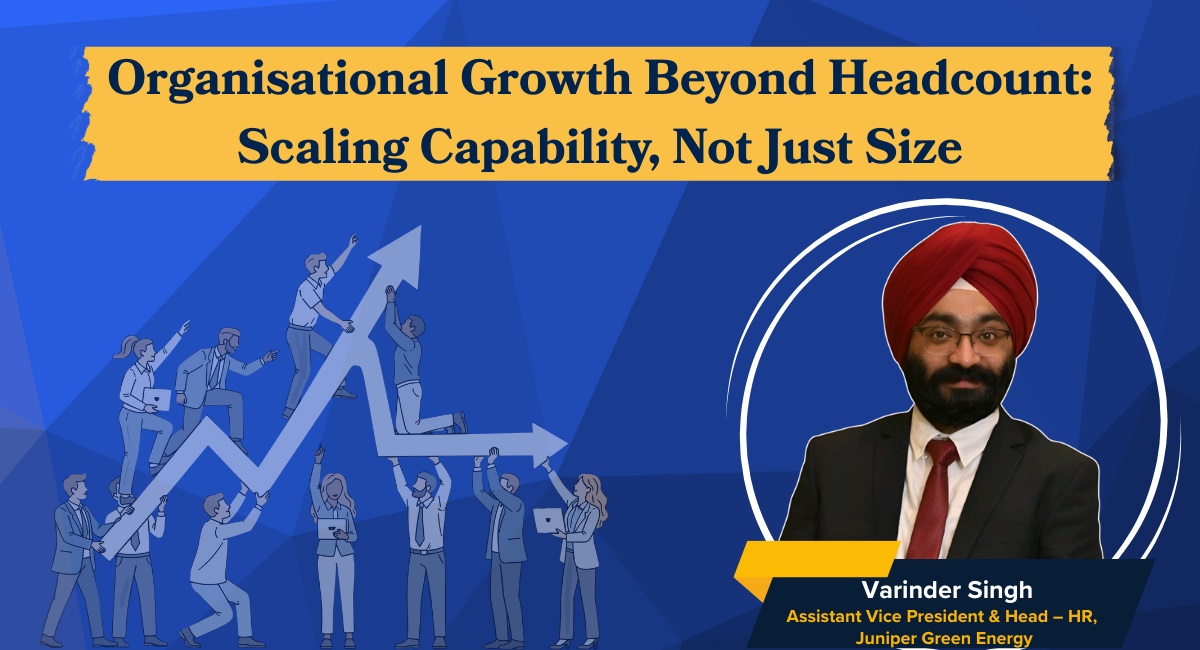
The future of organisational growth will not be defined by how many people we add, but by how capable, adaptable and empowered those people are.
As HR Leaders, our mandate is clear: Growth beyond headcount is not about doing more with less. It is about doing better with what we have and building what we truly need for the future.