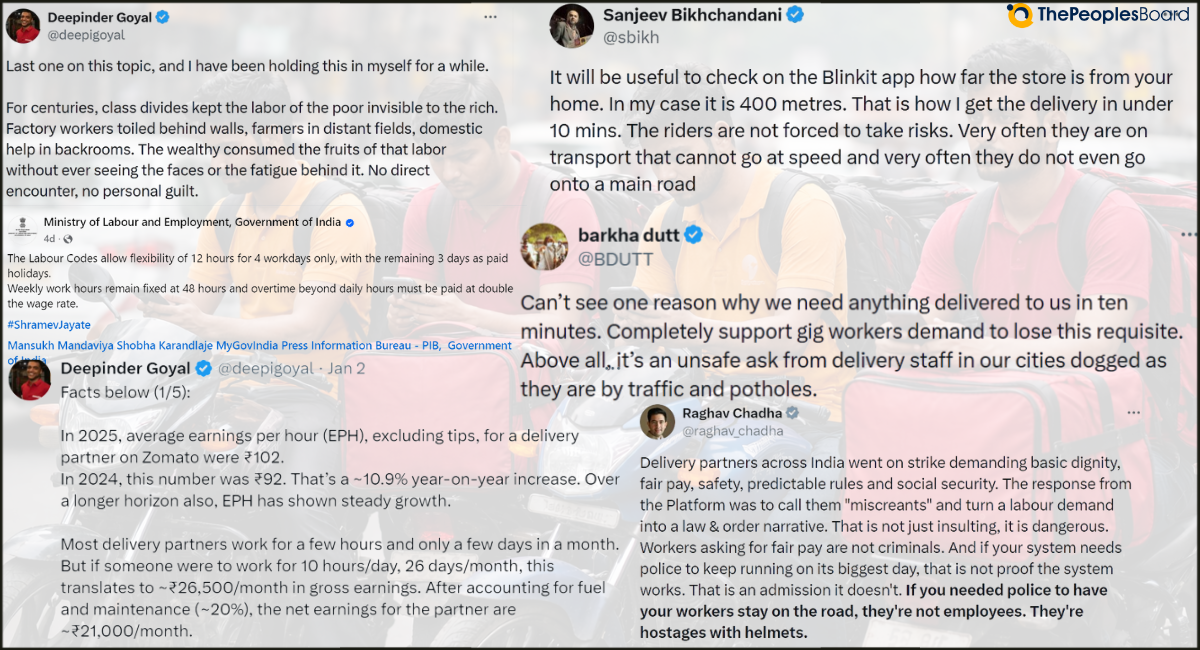

Some agitating platform workers, a chain of social media posts and Zomato founder Deepinder Goyal’s statements. This is how the new year started for the Indian quick commerce and food aggregator industries.
The saga began with a strike called by the Gig and Platform Services Workers Union (GIPSWU) on December 25, 2025, which extended to December 31, raising questions about the ambitious goals of the central government regarding the gig economy, as noted in the latest labour code reforms.
GIPSWU reportedly submitted a memorandum to the Union Labour and Employment Minister Mansukh Mandaviya demanding immediate government intervention to address the “systemic exclusion” and “exploitation” of gig workers under India’s labour framework.
Here are some of the key demands placed by the union, as reported by the Times of India:
- Better pay and predictable earnings rather than fluctuating per-order payouts.
- Safer working conditions, especially given the intense pressure of ultra-fast delivery commitments.
- Legal recognition as workers with social security benefits.
- End to arbitrary account deactivations and algorithmic penalties.
What triggered these demands?
On speaking with some delivery partners working for these platforms, ThePeoplesBoard learnt that the primary demands aren’t much about the 10-minute delivery time frame. Rather, it is about the earnings.
A Gurugram-based Zomato delivery partner shared with ThePeoplesBoard that the primary demand is to increase the earnings per kilometre. He further said, “Accepted orders often get transferred to other delivery partners when pickup delays for even 10 minutes.”
Comparing the working conditions with those of his previous employer, Swiggy, he noted that things are a bit better there. However, he refrained from commenting any further about why he left Swiggy or the other details.
Yet another Gurugram-based Zepto delivery partner shared that their income since the last few months has decreased significantly. “I started working for Zepto about two years ago. Earlier, I used to earn about Rs. 1,500 per 50 deliveries, but now I get approximately Rs. 1,000 for the same quantity,” he claimed. He further attributed this to the increase in the number of delivery partners.
However, he praised Zepto for listening to the partners’ side of the stories in case of customer complaints, which wasn’t typically the case for his previous employer, Blinkit. He said, “Blinkit would simply deduct money from our account in case of a customer complaint without much discussion. But with Zepto, things are better as clicking the product photo at the time of delivery is mandatory here, which helps us with a ground to prove ourselves.”
ThePeoplesBoard independently spoke to multiple delivery partners for this story. The claims shared reflect their personal experiences and have not been independently verified with the platforms.
However, the social media debates reflect that there is a misunderstanding about the demands and distress.
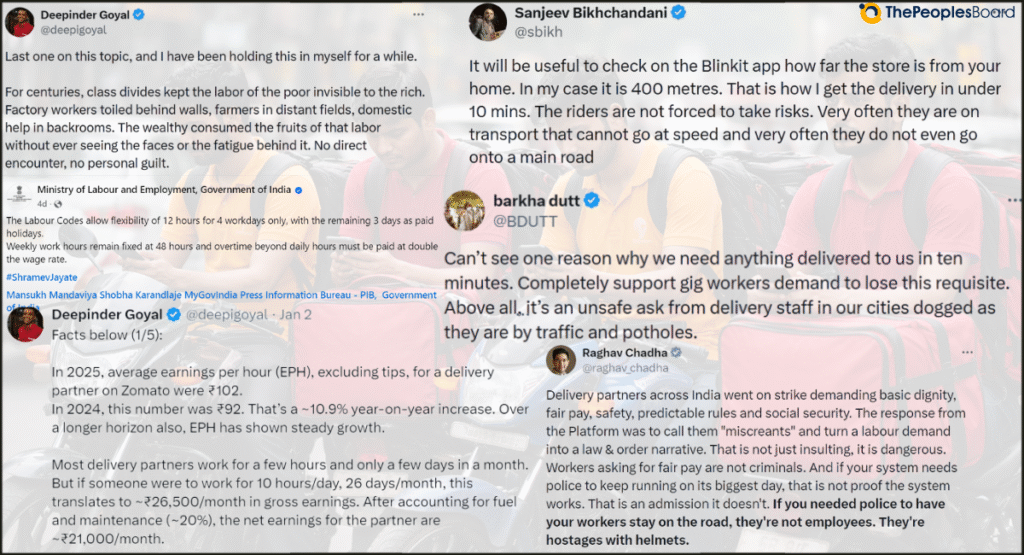
For instance, Aam Aadmi Party MP Raghav Chadha advocated for these partners on social media. Taking to X, he wrote, “This protest was not about disruption, but about being heard. I stand with them in solidarity. I hope the management of platforms like Blinkit, Zepto, Swiggy, Zomato, etc., listens and engages sincerely.”
Further, senior journalist Barkha Dutt wrote on X, “Can’t see one reason why we need anything delivered to us in ten minutes. Completely support gig workers demand to lose this requisite. Above all, it’s an unsafe ask from delivery staff in our cities dogged as they are by traffic and potholes.”
In response to such criticisms, Zomato’s CEO, Deepinder Goyal, on social media, stated that these jobs are a livelihood for many. A ban on this will negatively impact a lot of people.
Arguing about the delivery time frame, Goyal clarified, “Our 10 minute delivery promise is enabled by the density of stores around your homes. It’s not enabled by asking delivery partners to drive fast… After you place your order on Blinkit, it is picked and packed within 2.5 minutes. And then the rider drives an average of under 2km in about 8 minutes. That’s an average of 15kmph.”
Angel investor and Info Edge founder Sanjeev Bikhchandani came out in support of Goyal on X. He wrote, “It will be useful to check on the Blinkit app how far the store is from your home. In my case it is 400 metres. That is how I get the delivery in under 10 minutes. The riders are not forced to take risks.”
But the debate seems to be taking two different directions. While the workers demand better pay and working conditions, experts are debating the delivery time frame, reflecting a complete mismatch.
How will the issue be resolved if nobody is on the same page?
Interestingly, the dispute arises against the backdrop of the integration of 26 labour codes into four. Under the Code on Wages and the Code on Social Security, gig workers have been defined and given attention to, for the formalisation of labour and offering them social security benefits, including health insurance, ESIC registration, etc.
But is that enough?
Probably even the government has an answer – “no”. Considering the better job security of the gig workers, the government redefined the employment of a gig worker with these aggregators or platforms in the draft rules for the four Labour Codes that were introduced in late 2025.
Here’s what the new rules state:
- A gig worker has to be engaged with an aggregator for at least 90 days to be eligible for social security benefits. In case he works with more than one aggregator, the threshold must be 120 days.
- A gig worker will be considered employed with an aggregator for one calendar day, irrespective of their earnings on that day.
- In case of being associated with multiple aggregators, the number of days should be calculated in a cumulative manner.
- If a gig worker or a platform worker serves three companies on the same day, it should be considered as three calendar days.
After this list was announced by the labour ministry, MP Rahav Chadha congratulated the workers on an Instagram post, writing, “Delivery Partners. There is good news for you. Central Government’s draft Social Security Rules are the first step towards recognition, protection and dignity for your work. Even though the Platforms (Zomato, Swiggy, Blinkit, etc.) chose not to listen to your voices, the people of this country and the government did.”
Seemingly, there was a wide communication gap between the workers, the aggregators and the government.
As rightly pointed out by Deepinder Goyal during an interaction with podcaster Raj Shamani, “Sabke apne apne versions of truth hote hai (everyone has his own version of truth).”
A Bain and Company study found that the Indian quick-commerce industry is projected to grow by over 40% annually until 2030, with new entrants such as Flipkart Minutes, Myntra’s M-now, BigBasket’s BB Now, and more joining the race.
Under such circumstances, how such debates shape the future will be interesting to look at.
Otherwise, as Goyal wrote on X, “Now, every doorbell ring is a reminder of systemic inequality. That’s why debates explode. It’s not just policy. It’s emotional reckoning. Some defend the system (“they choose it”), others demand change (“this isn’t progress, it’s exploitation”).”