

As we head towards 2026, HR leaders look forward to transformation, as that has been constant among the HR fraternity over the last few years. The shifts have been shaped by uncertainty and shifting expectations from both businesses and employees.
What began as a response to a pandemic-like crisis has steadily evolved into a broader transformation of how organisations think about people, work, and capability. This paradigm shift has not been confined to any one sector or company size; rather felt across industries, making HR one of the most dynamically evolving functions in the enterprise. As organisations look ahead, 2026 stands out as a year where many of these changes are expected to mature.
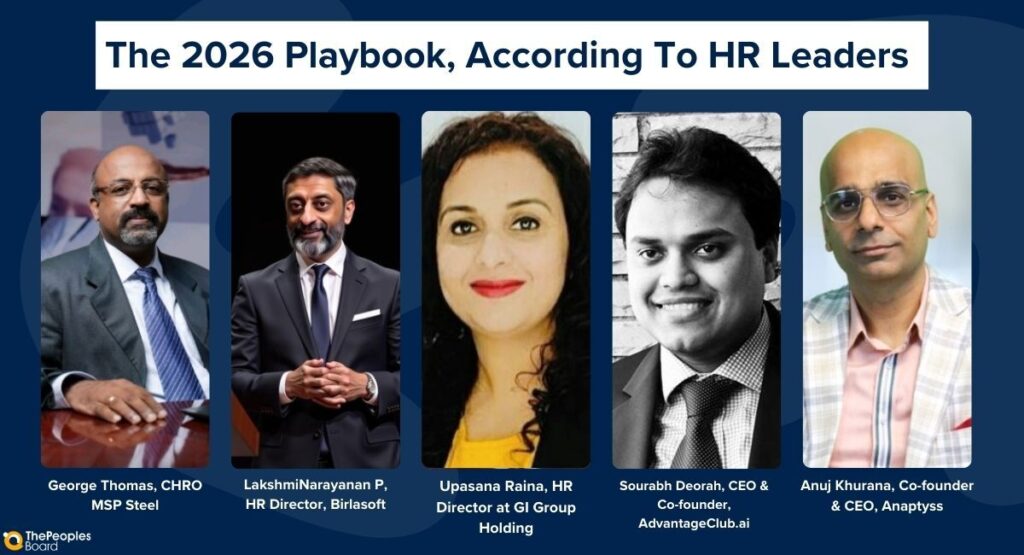
Against this backdrop, ThePeoplesBoard has curated a set of perspectives from leaders across industries, capturing their expectations of how HR will evolve in 2026.
- Upasana Raina, HR Director at GI Group Holding (Staffing Industry)
“The ever-changing and growing global and Indian business world will impact the trends of the Human Resource function in 2026 and require far more nimble and flexible approaches in Human Resource policies. AI will increasingly find applications in organisations to enable better decision-making, increased productivity, and personalisation of the employee experience across the entire talent life cycle.
The Employee Value Proposition will be and should be evolved and clarified as an area of focus. To attract and retain the brightest and the best talent even in such an intensely competitive marketplace, organisations must communicate their Employee Value Proposition consistently.”
- George Thomas, CHRO MSP Steel (Heavy and Core Industries)
“In 2026, we are going for digital transformation. At MSP Steel, we have implemented an LMS (Learning Management System) for our employees. This will help our employees to learn anywhere any anytime. Going forward, AI, Automation, and Agentic AI will reshape the HR function.
The HR functions will rely heavily on AI for hiring, payroll, workforce analytics and digital employee experience in 2026. Lastly, employee wellness is going to be a strategic business priority for HR.”
- Sourabh Deorah, CEO & Co-founder, AdvantageClub.ai (Startups)
“As we head into 2026, the conversation is shifting from ‘where’ we work to ‘how we feel’. For a long time, HR tech was built for companies to manage employees; now it’s finally being built for employees to feel seen by their companies. By 2026, the ‘average employee’ will be a myth.
In the startup business, we are entering the era of the ‘Segment of One’, where workplace policies aren’t just flexible, they’re hyper-personalised. With Agentic AI, we’re moving past static dashboards to a world where technology scales empathy, not just efficiency. The goal isn’t just to make work faster; it’s to make it feel deeply personal, ensuring every individual’s moments that matter are recognised in real-time, automatically.”
- LakshmiNarayanan P, HR Director, Birlasoft (IT Firm)
“In the IT sector, customers nowadays demand a multitude of skills. So, in 2026, workforce management will come with skills at the core, which is not going to be easy. In the next year, skills will be treated as new currency for any Hr function. And, I think AI will be able to help enable this transition through deeper intelligence systems.”
- Anuj Khurana, Co-founder & CEO, Anaptyss (BFSI)
“2025 has been a defining year for the BFSI industry as it has restructured its workforce around technology, data, and risk resilience. Looking ahead to 2026, BFSI talent demand is expected to remain strongly skewed toward digital-first and risk-led skillsets, with sustained hiring across AI/ML engineering, data science and analytics, cybersecurity, cloud and platform engineering, regulatory technology (RegTech), model risk management, and digital lending platform engineering.
Driven by cost efficiencies, talent availability, and scalable delivery models, BFSI/BFSI GCCs are also expected to accelerate execution from tier-2 cities such as Surat, Lucknow, Coimbatore, and Indore, complementing established metro hubs.”